Push-up (Banded)
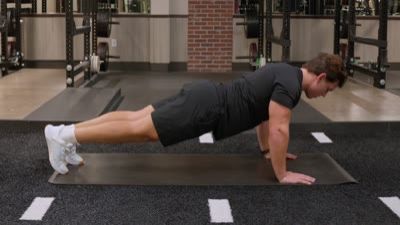
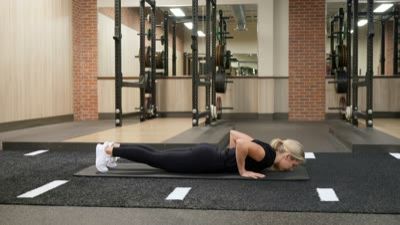
A strength-focused variation of the standard push-up that uses a resistance band to increase load at the top of the movement. This exercise targets the chest, triceps, and shoulders with accommodating resistance to build explosive upper body power.
Iridium treats this as a loaded bodyweight movement, relying on your RPE inputs to gauge intensity since band tension is variable. Programs count this specific volume toward your Middle Chest and Triceps fatigue scores, checking your 7-day history to ensure your anterior deltoids have recovered from recent heavy pressing. When progression is needed, Iridium analyzes your rep trends to recommend either increased volume or a shift to a heavier band.
Form Cues
- Loop the band securely across your upper back and under your palms
- Keep your elbows tucked at a 45-degree angle to your torso
- Brace your core and squeeze your glutes to maintain a rigid straight line
- Drive your hands hard into the floor to fully extend elbows at the top
- Control the descent against the tension of the band
- Don't let your hips sag or your lower back arch
- Don't flare your elbows out to the sides (forming a 'T' shape)
- Don't bob your head forward to reach the ground
- Don't let the band snap you down into the bottom position
Common Mistakes
- Band slipping due to loose grip
- Incomplete lockout at the top
- Sagging hips breaking the plank line
- Flaring elbows too wide
- Rushing the negative portion
Muscles Worked
This exercise places significant demand on the pectoralis major (middle chest) and triceps, utilizing accommodating resistance to maximize tension at the peak of the contraction. It also heavily recruits the anterior deltoids and serratus anterior for shoulder stability, while the core muscles work isometrically to prevent spinal extension against the added load.
Primary
Secondary
Get Personalized Coaching for Push-up (Banded)
Don't guess your way through weights or workouts. Download Iridium for automatic, AI-powered coaching that adapts to your recovery and goals.