Banded Y Fly
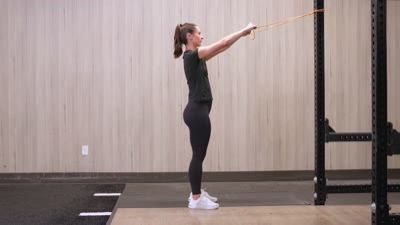
The Banded Y Fly is a shoulder health exercise that strengthens the rear deltoids and lower trapezius by raising resistance bands overhead in a 'Y' formation. This movement improves posture, scapular stability, and overhead mobility.

Since resistance bands offer variable tension, Iridium relies heavily on your RPE feedback rather than absolute weight to gauge intensity and drive progression for this movement. The AI positions this exercise to minimize interference with heavy compounds, ensuring your posterior deltoids receive targeted volume without exceeding their Maximum Recoverable Volume after main back work.
Form Cues
- Stand tall with your core braced and glutes squeezed
- Initiate the movement by depressing your shoulder blades down
- Raise your arms up and out at a 45-degree angle
- Keep your elbows straight but not hyper-extended
- Pause at the top and squeeze your lower traps
- Don't shrug your shoulders up toward your ears
- Don't arch your lower back to lift the bands
- Don't let the bands snap your arms back down quickly
- Don't jut your head forward as you raise your arms
Common Mistakes
- Shrugging the upper traps
- Arching the lumbar spine
- Bending the elbows excessively
- Using momentum to swing up
- Rushing the lowering phase
Muscles Worked
This exercise primarily targets the posterior deltoids and the lower fibers of the trapezius, which are critical for stabilizing the shoulder blade against the ribcage. It also engages the lateral deltoids and rhomboids, helping to counteract the rounded-shoulder posture often caused by frequent sitting.
Primary
Secondary


Get Personalized Coaching for Banded Y Fly
Don't guess your way through weights or workouts. Download Iridium for automatic, AI-powered coaching that adapts to your recovery and goals.