MEV, MAV, and MRV Explained: The Volume Landmarks That Define Your Training
Decode the science of training volume with this comprehensive guide to MEV, MAV, and MRV. Learn how to find your optimal volume thresholds for maximum muscle growth.
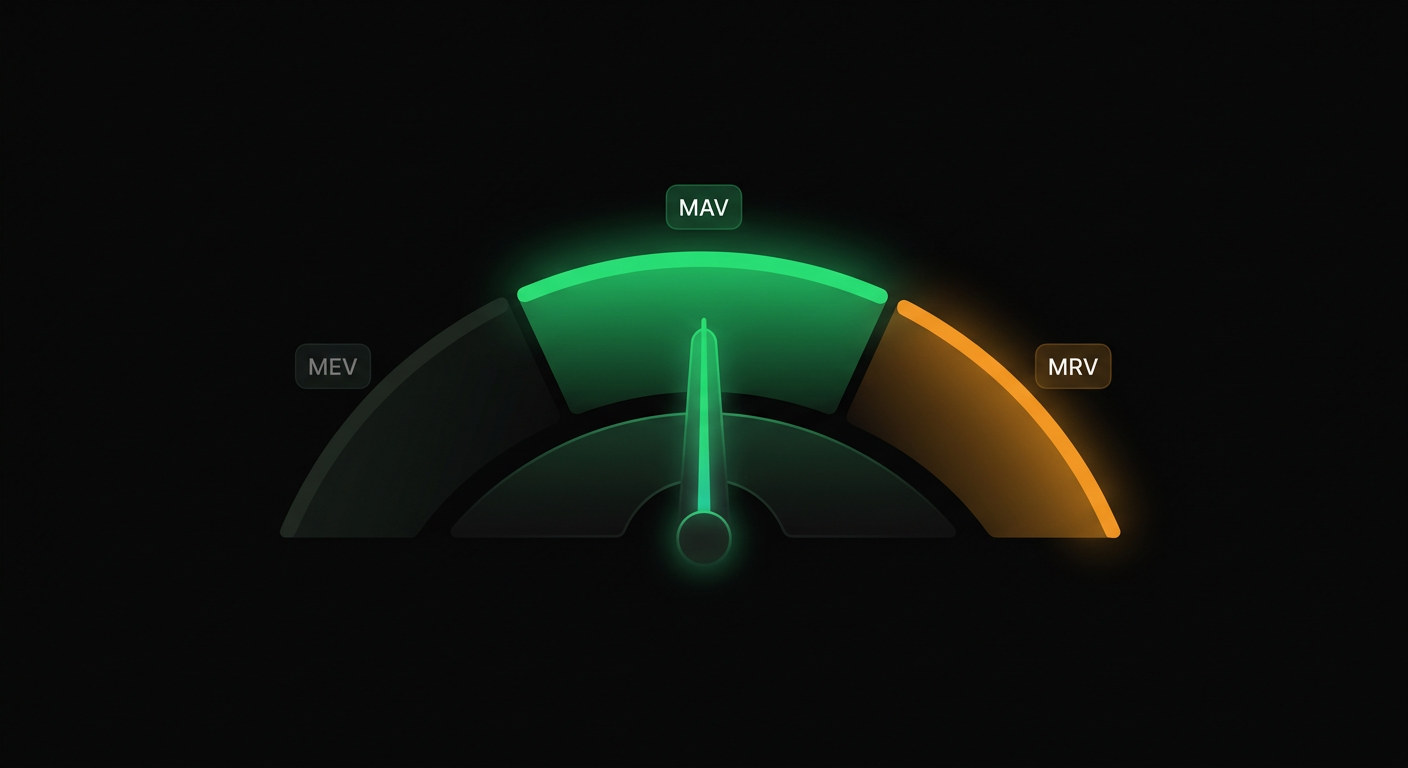
If you've spent time in evidence-based lifting circles, you've encountered the acronyms: MEV, MAV, MRV. Maybe you've seen them thrown around on Reddit or mentioned by coaches. But do you actually know what they mean for your training?
These aren't just jargon—they're the conceptual framework that separates intelligent programming from "more is better" or "whatever feels right." Understanding these volume landmarks transforms how you design and adjust training programs.
Let's break down each concept, why it matters, and how to find your individual thresholds.
The Volume Spectrum: From Minimum to Maximum
Think of training volume as existing on a spectrum. Too little, and you're not providing enough stimulus to drive adaptation. Too much, and you're accumulating fatigue faster than you can recover. Somewhere in between is the sweet spot.
Dr. Mike Israetel and Renaissance Periodization popularized this framework, giving us clear terminology for different points on the volume spectrum:
- MV (Maintenance Volume): Minimum to maintain current adaptations
- MEV (Minimum Effective Volume): Minimum to drive new adaptations
- MAV (Maximum Adaptive Volume): Optimal range for growth
- MRV (Maximum Recoverable Volume): Upper limit before recovery fails
Let's unpack each one.
MV: Maintenance Volume
Definition: The minimum volume required to maintain your current muscle mass and strength.
For most muscle groups, MV sits around 4-6 hard sets per week. Yes, that's shockingly low if you're already developed. But once you've built muscle, maintaining it requires far less stimulus than building it in the first place.
When MV Matters
During deloads: You're not trying to grow; you're managing fatigue. Drop to MV for a week to recover while preventing detraining.
When injured: If you've got a nagging shoulder issue, you might maintain chest with a few sets of DB pressing while letting the joint recover.
During cuts: When you're in a caloric deficit, your recovery capacity is reduced. Sometimes maintaining muscle while losing fat means accepting MV for certain groups.
During specialization: If you're focusing heavily on bringing up your legs, you might let upper body drop to MV to free up recovery resources.
The MV Mistake
Don't confuse "maintenance" with "easy." These sets still need to be hard, quality work. Four sets of lazy bench press aren't MV—they're wasted time.
MEV: Minimum Effective Volume
Definition: The minimum volume required to make continued progress (muscle growth or strength gains).
MEV is typically around 6-10 sets per muscle group per week, though this varies significantly based on training status, genetics, and muscle group.
Why MEV Exists
There's a threshold effect with training volume. Below a certain point, the stimulus simply isn't strong enough to trigger meaningful adaptation, especially for trained lifters. Your body is lazy—it won't build new muscle tissue unless it's forced to.
For beginners, MEV might be incredibly low (3-4 sets per muscle per week might drive growth). For advanced lifters, MEV creeps up because you're more adapted to training stimulus.
MEV in Practice
MEV represents the minimum viable program. If you're time-crunched, stressed, traveling, or just need to pull back temporarily, training at MEV keeps you making progress (albeit slowly) without pushing recovery limits.
A minimalist program hitting MEV for all major muscle groups might look like:
- Chest: 6 sets
- Back: 8 sets
- Quads: 8 sets
- Hamstrings: 6 sets
- Delts: 6 sets
- Arms: 6 sets each
That's a 40-set-per-week program. You could hit this in three workouts. Progress would be slow, but it would happen.
The MEV Trap
Don't train at MEV when you have the capacity for more. MEV is your minimum, not your target. If you're recovered, sleeping well, and have the time, pushing closer to MAV will yield better results.
MAV: Maximum Adaptive Volume
Definition: The volume range that produces the best progress relative to fatigue cost.
This is your Goldilocks zone—not too little, not too much. For most lifters and muscle groups, MAV sits around 12-20 sets per week.
Why MAV Is Your Target
At MAV, you're providing enough stimulus to drive meaningful adaptation while managing fatigue well enough to sustain that volume week after week. This is where you want to live most of the time when growing a muscle group is the goal.
Below MAV, you're leaving gains on the table. Above MAV, you're accumulating fatigue that will eventually require backing off, making it unsustainable long-term.
Finding Your MAV
This is where individual variation matters enormously. Your MAV for quads might be 16 sets. Your training partner's might be 12 or 22.
Factors that influence MAV:
- Training age: Advanced lifters often need more volume
- Genetics: Some people are volume responders, others aren't
- Recovery capacity: Sleep, stress, nutrition all impact this
- Muscle group: Back can often handle more volume than biceps
- Exercise selection: Less fatiguing exercises allow higher volume
The only way to find your MAV is through experimentation and tracking. Start conservatively (maybe 12-14 sets for major muscle groups), track progress over 3-4 weeks, then adjust.
If you're progressing well and recovery feels solid, you might be below MAV—try adding volume. If you're grinding, feeling beat up, and progress is stalling, you might be past MAV—reduce volume.
MAV Changes Over Time
Your MAV isn't static. As you get stronger, more advanced, and better conditioned, your MAV typically increases. Conversely, during stressful life periods or when cutting calories, your MAV might drop.
This is why intelligent programming adjusts volume based on current context, not just following a static plan.
Iridium's AI tracks your volume trends and performance over time, identifying when you're in your MAV sweet spot versus when you're undershooting or overshooting. Instead of guessing, you get data-informed guidance about whether to push volume up or dial it back.
MRV: Maximum Recoverable Volume
Definition: The maximum volume you can recover from while still making progress.
MRV is your upper limit. Push past this, and you're no longer recovering adequately between sessions. Fatigue accumulates, performance degrades, and you're on the express train to overtraining.
For most lifters, MRV sits around 18-28 sets per week per muscle group, but this varies wildly.
When You Hit MRV
Signs you've exceeded MRV:
- Performance declining despite adequate effort
- Persistent soreness that doesn't resolve normally
- Sleep disruption or elevated resting heart rate
- Motivation tanking (not just having an off day—sustained apathy)
- Nagging joint pain or injury risk feeling high
Strategic Use of MRV
Here's the interesting part: temporarily pushing to MRV can be useful. During a 2-3 week overreaching phase, you intentionally accumulate fatigue, then deload hard. The supercompensation from this can drive a performance spike.
But this only works if:
- It's planned and temporary (2-3 weeks max)
- You follow it with adequate deload (1-2 weeks)
- You're honest about when you've hit MRV (not ego-driven pushing)
The MRV Mistake
Most lifters exceed MRV by accident, not by design. They keep adding volume because "more is better," or they're not tracking and don't realize they've crept from 14 sets per week to 26 sets over a few months.
This is why tracking volume is non-negotiable for serious lifters. You can't manage what you don't measure.
Putting It All Together: Volume Periodization
Understanding MEV, MAV, and MRV allows you to periodize intelligently:
Accumulation Phase (3-4 weeks)
- Start at low-to-mid MAV
- Gradually increase volume toward upper MAV or even MRV
- Manage fatigue with exercise selection and intensity
Deload Phase (1 week)
- Drop to MV or slightly above
- Reduce intensity slightly
- Allow systemic recovery
Intensification Phase (2-3 weeks)
- Return to MAV
- Push performance with recovered capacity
- Aim for PRs and quality over pure volume
This creates a sustainable cycle of progress without grinding yourself into dust.
Individual Variation: Why Cookie-Cutter Programs Fail
Here's the uncomfortable truth: the volume landmarks that work for someone else might be completely wrong for you.
A study might show average hypertrophy-optimizing volume is 15 sets per muscle per week. But averages hide massive individual variation. Some subjects in that study probably responded best to 10 sets, others to 22.
Your genetics, training history, recovery capacity, exercise selection, and technique all influence your MEV, MAV, and MRV. The only way to find yours is through systematic tracking and adjustment.
This is exactly why Iridium focuses on individual response rather than generic recommendations. The app tracks your volume, monitors your performance, and learns what works for you specifically—not what works for the average person in a study.
Practical Application: Finding Your Landmarks
Week 1-2: Baseline
- Train at conservative volume (12-14 sets for major groups)
- Track performance carefully
- Establish your baseline
Week 3-5: Exploration
- Gradually add volume (1-2 sets per week)
- Monitor recovery and performance
- Watch for positive response (better pumps, strength gains, muscle fullness)
Week 6-8: Refinement
- If still feeling good, continue adding volume until you hit signs of MRV
- If performance plateaus or fatigue accumulates, you've likely exceeded MAV
- Note where sweet spot seems to be
Week 9: Deload
- Drop to MV
- Recover
Week 10+: Optimize
- Return to the volume range that felt best (your current MAV)
- Make micro-adjustments based on ongoing tracking
This process takes time, but it's worth it. Once you know your landmarks, programming becomes dramatically more effective.
The Volume-Response Curve
Here's a helpful mental model:
- Below MEV: Flat line (no meaningful progress)
- MEV to MAV: Steep upward curve (more volume = more gains)
- MAV to MRV: Diminishing returns (more volume = slight gains at high fatigue cost)
- Above MRV: Downward curve (more volume = regression)
Your goal is to operate in the MAV zone most of the time, occasionally dipping to MEV during deloads or pushing to MRV during planned overreaching.
Stop Guessing, Start Tracking
Understanding MEV, MAV, and MRV conceptually is valuable. Actually finding and applying your individual landmarks? That's where real progress happens.
This requires consistent volume tracking, performance monitoring, and honest assessment of recovery. It's not complicated, but it does require discipline.
Ready to find your optimal volume? Download Iridium and let intelligent tracking show you exactly where your MEV, MAV, and MRV sit for each muscle group. Stop following generic programs and start training optimized for you.
Related Posts
Fasted Training: Pros, Cons, and Who It's For
Should you work out on an empty stomach? We break down the science of fasted training, its effects on fat loss and muscle, and practical tips.
Intermittent Fasting for Lifters: Does It Help or Hurt Gains?
Can you build muscle with intermittent fasting? The research on IF protocols, muscle growth, strength, and practical strategies for lifters.
Periodization Made Simple
Workout periodization doesn't have to be complicated. Learn about linear, undulating, and block periodization with practical examples for real lifters.