Mind-Muscle Connection: Techniques and Benefits
Learn what mind-muscle connection actually is, how to develop it, and whether focusing on feeling the muscle helps you build more muscle.
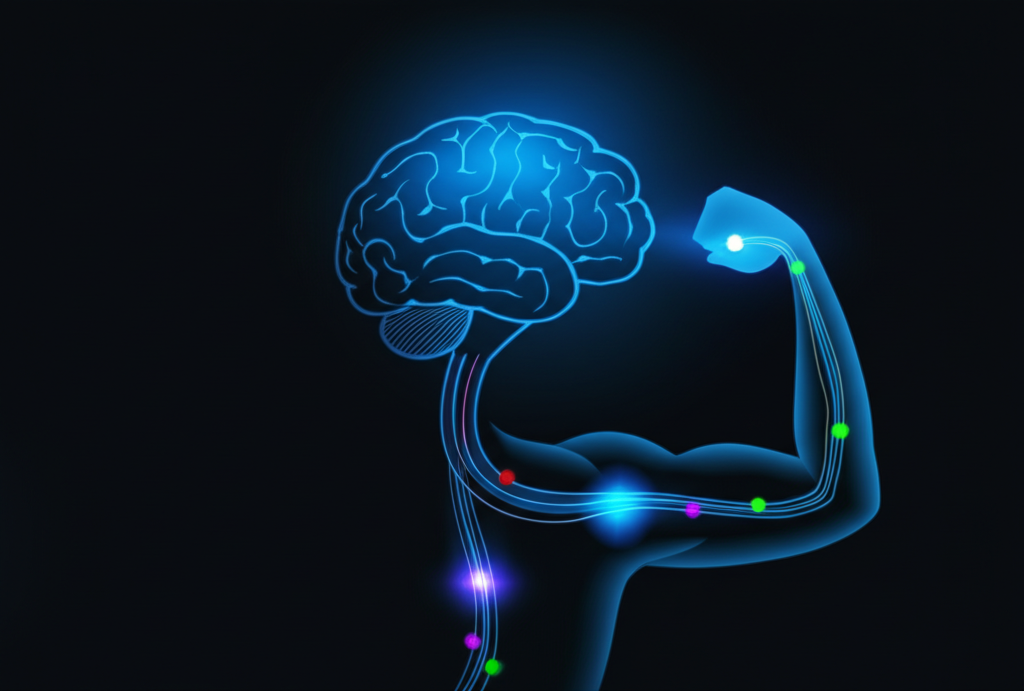
"Feel the muscle burning." "Squeeze at the top." "Focus on the contraction."
If you've spent time in a bodybuilding-oriented gym, you've heard these cues endlessly. The concept of mind-muscle connection is taken as gospel in bodybuilding: focusing intently on the target muscle supposedly leads to greater hypertrophy.
Is this backed by science, or is it just gym folklore?
The answer is more nuanced. Mind-muscle connection is real and measurable — but it's not magic, and it's not always necessary for gains.
What Is Mind-Muscle Connection?
Mind-muscle connection refers to the conscious focus on contracting a specific muscle during an exercise. Instead of just moving the weight from point A to point B, you're actively thinking about and trying to feel the target muscle working.
This isn't just psychological. It involves actual neuromuscular processes:
- Selective motor unit recruitment: Firing the motor units that control the target muscle while minimizing help from synergists
- Rate coding: Increasing the firing frequency of those motor units
- Inhibition of compensatory muscles: Reducing the contribution of stronger or more dominant muscles
When a lifter focuses on feeling their chest during bench press, they're (consciously or unconsciously) trying to use their chest muscles more and their triceps and shoulders less.
The Research Evidence
EMG Studies Show It Works
Electromyography (EMG) measures muscle electrical activity — essentially how hard a muscle is working. Multiple EMG studies have found that conscious focus increases activation in target muscles.
A study by Snyder & Leech, 2009 had trained lifters perform bicep curls with two different cues: "lift the weight" vs "focus on your biceps." The biceps-focused condition produced significantly greater EMG activity.
Similar findings have been replicated across various movements. When you focus on the target muscle, it tends to contract harder.
But Does It Build More Muscle?
Here's where it gets tricky. Greater muscle activation in a single set doesn't necessarily mean greater hypertrophy over time.
A critical study by Morton et al., 2018 compared low-load training taken to failure (which naturally promotes focus on the target muscle) vs high-load training (which requires more global attention to moving heavy weight). Despite different levels of conscious focus, both groups achieved similar hypertrophy.
This suggests that while mind-muscle connection can increase muscle activation, it may not be a primary driver of growth — provided sets are taken close to failure.
The Role of Movement Speed
One way mind-muscle connection might help is by slowing down movement. When you're focusing on feeling the muscle, you naturally move more deliberately.
Research by Schoenfeld et al., 2015 found that controlled tempos (particularly slower eccentric phases) increased time under tension and muscle activation in targeted muscles. The mind-muscle focus indirectly promotes this through intentional movement speed.
When Mind-Muscle Connection Matters
Isolation Exercises and Weak Points
Mind-muscle connection is most valuable for isolation movements and targeting lagging body parts.
When you're doing bicep curls, lateral raises, or leg extensions, there's no systemic advantage to moving the weight quickly. The entire point is to maximally stimulate a single muscle. Here, conscious focus is almost always beneficial.
Similarly, when you're trying to bring up a weak body part — rear delts in many lifters, calves for others — mind-muscle connection helps ensure that muscle is doing its fair share of the work.
Higher Rep Ranges
At moderate to high rep ranges (10-20+ reps), you're not limited by absolute strength at any single rep. You have the mental bandwidth to focus on technique and muscle feel.
This is why many bodybuilders do higher rep sets during the off-season hypertrophy phase. The combination of moderate load, sufficient reps, and intentional focus creates an optimal environment for muscle growth.
Correcting Muscle Imbalances
If your left side is weaker than your right, or certain muscles lag behind, mind-muscle connection helps you consciously recruit the weaker side or undertrained muscle more effectively.
A da Silva et al., 2015 study found that unilateral training with focus on the target limb produced superior activation compared to bilateral training — suggesting that conscious attention helps correct imbalances.
When Mind-Muscle Connection Is Less Important
Heavy Compounds and Strength Training
When you're squatting for 5 heavy reps or bench pressing near your 5RM, your brain needs to focus on moving the weight safely. Dividing attention between "lift heavy" and "feel my quads" can actually reduce performance.
During true strength work, technique safety and overall coordination take priority. The muscles will fire regardless — your nervous system handles this automatically when the load is substantial enough.
Behm & Sale, 1993 found that during high-effort contractions, attentional focus has diminishing returns on performance. The neural demand of moving heavy loads engages the appropriate muscles whether you're consciously focusing or not.
Sets Taken to Failure
Here's an important nuance: when sets are taken to or very close to failure, mind-muscle connection becomes less relevant for hypertrophy.
Morton et al., 2018 demonstrated that when sets reach failure, muscle fibers are maximally recruited regardless of conscious focus. The biological need to complete the rep drives full motor unit recruitment.
The caveat: ensuring you're actually reaching failure on the target muscle, not compromising form as synergist muscles give out first.
How to Develop Your Mind-Muscle Connection
Start with Lighter Loads
It's impossible to focus on muscle feel when you're struggling to complete a rep. Practice mind-muscle connection with submaximal loads (50-60% of 1RM) where you have complete control.
Use these lighter sets as a warm-up and neural primer. They improve your neuromuscular awareness which carries over to heavier work.
Use Cues Effectively
Good cues direct attention to the right place. Bad cues confuse rather than clarify.
Effective cues:
- "Squeeze your chest at the top" (bench press flyes)
- "Pull with your back, not your arms" (lat pulldowns)
- "Push through your heels" (squats)
- "Drive your elbows forward" (lateral raises)
Ineffective cues:
- "Feel the burn" (subjective and unactionable)
- "Just think about the muscle" (vague)
- Don't know what "contracting" should feel like
Use concrete, technical cues that tell your body what to do.
Slow Down the Eccentric
The eccentric (lowering) phase is where you have the most control and where most of the damage stimulus occurs. Slow this down deliberately — 2-3 seconds on most exercises, 3-4 seconds for isolation work.
Schoenfeld et al., 2015 found that slower eccentrics increased muscle activation and hypertrophy compared to faster, more "explosive" tempos in isolation movements.
Remove Distractions
You can't focus on muscle feel if you're scrolling TikTok between sets, blasting music, or chatting with gym friends.
During your working sets, eliminate external distraction. Put your phone away. Use headphones if music helps focus, but don't check Instagram between reps. Give your training session the mental attention it deserves.
Practical Training Application
Lower Body Push Day (Focus-Heavy)
| Exercise | Sets | Reps | Focus |
|---|---|---|---|
| Leg Extensions | 4 | 15-20 | Feel quads fully contract |
| Squats | 4 | 6-8 | Drive through heels, full depth |
| Romanian Deadlifts | 4 | 10-12 | Hamstring stretch and squeeze |
| Bulgarian Split Squats | 3 | 10-12 | Feel target leg working |
| Leg Curls | 3 | 15-20 | Hamstring squeeze hold |
| Calf Raises | 4 | 15-20 | Slow eccentric, hold stretch |
Iridium creates focus-specific workouts — you can tell the app you want a "mind-muscle connection" session and it builds a program with isolation work, moderate tempos, and lighter loads that enhance muscle awareness. Conversely, for strength-focused days, it uses heavy compounds where intensity naturally drives recruitment. Two different training modes for different goals.
Upper Body Pull Day (Hybrid)
| Exercise | Sets | Reps | Focus |
|---|---|---|---|
| Barbell Rows | 4 | 6-8 | Strength focus: heavy weight |
| Lat Pulldowns | 4 | 10-12 | Pull from lats, not arms |
| Face Pulls | 3 | 15-20 | Feel rear delts contracting |
| Incline Curls | 3 | 10-12 | Bicep squeeze at top |
| Hammer Curls | 2 | 12-15 | Brachialis focus |
Notice the progression: heavy row for strength first, then progressively more focus-oriented movements as fatigue accumulates.
The Bottom Line
Mind-muscle connection is real, measurable through EMG, and can enhance muscle activation — but it's not a magic bullet for hypertrophy.
It matters most for:
- Isolation exercises
- Weak point training
- Higher rep ranges
- Correcting muscle imbalances
It matters less for:
- Heavy compounds at low rep ranges
- Sets taken to genuine failure
- Pure strength training phases
The best approach is situational. Use mind-muscle focus when it's appropriate — isolation work, moderate reps, targeted muscle training. Focus on moving heavy weight safely when strength is the priority.
There's value in both approaches. Skilled lifters switch between them based on the exercise, rep range, and training block. Develop your connection to your muscles, but don't treat it as the only path to growth.
Sometimes the best training is just showing up, working hard, and letting your body handle the details.
Iridium Makes Focus Easy
Iridium lets you toggle between training modes based on your session goals. Use "Strength" mode for heavy compounds where intensity builds power, or "Hypertrophy" mode for focus-oriented isolation work where mind-muscle connection matters most. The app adjusts your exercise selection, tempos, and rep ranges accordingly — so you train optimally without reprogramming every workout.
Related Posts
Tempo Training: Does Rep Speed Actually Matter?
The science of tempo training: how rep speed affects muscle growth, strength, and technique. Learn when to use different tempos and how to program them.
Time Under Tension: Does It Matter?
Unpack the science behind time under tension (TUT) for muscle growth. Learn what research actually shows about rep tempo and how to apply it practically to your training.
How to Use RPE in Your Training
A practical guide to using RPE in your workouts. Learn how to rate sets accurately, avoid common mistakes, and program with RPE for better results.