Lateral Step Up
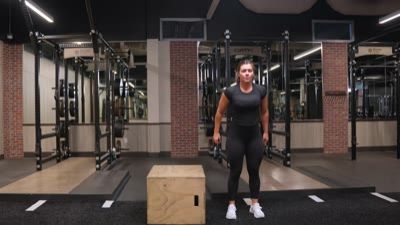
The Lateral Step Up is a functional lower-body exercise that targets the quadriceps and glutes while significantly improving hip stability. By stepping sideways onto an elevated surface, you specifically engage the outer hip muscles (gluteus medius) often neglected in standard squats and lunges.
Iridium uses the Lateral Step Up to fill volume gaps for the adductors and glutes while sparing the lower back, tracking these sets against your Maximum Recoverable Volume. As a unilateral exercise, the algorithm factors in the additional time required per set to ensure the total workout fits your schedule constraints. RPE data is monitored closely to verify that the load is sufficient to drive adaptation despite the movement's stability requirements.
Form Cues
- Stand sideways next to a sturdy box or bench
- Place your entire foot flat on the box
- Drive forcefully through your elevated heel to stand tall
- Keep your hips square and facing forward
- Lower yourself slowly for a 3-second count
- Don't push off the floor with your bottom leg
- Don't let your knee cave inward as you step up
- Don't allow your heel to hang off the edge of the box
- Don't rush the downward phase of the movement
Common Mistakes
- Bouncing off the bottom foot
- Knee valgus (caving inward)
- Using a box that is too high
- Rapid, uncontrolled descent
- Rotating the hips during the step
Muscles Worked
This exercise primarily drives growth in the quadriceps and gluteus maximus through the stepping motion. Crucially, the lateral angle heavily recruits the gluteus medius and adductors to stabilize the pelvis, making it highly effective for correcting muscle imbalances and preventing knee injuries.
Primary
Secondary



Get Personalized Coaching for Lateral Step Up
Don't guess your way through weights or workouts. Download Iridium for automatic, AI-powered coaching that adapts to your recovery and goals.