Body Recomposition: Is It Possible?
Can you build muscle and lose fat at the same time? Evidence-based analysis of who can achieve body recomposition, the science, and how to do it.
You've probably heard it a thousand times: "You can't build muscle and lose fat at the same time." The logic sounds airtight — building muscle requires a caloric surplus, losing fat requires a deficit. You can't be in both simultaneously.
Except the research says otherwise. Body recomposition is real, it's documented in dozens of studies, and for certain populations, it's actually the optimal approach. Here's what the science says — and what it means for your training.
What Is Body Recomposition?
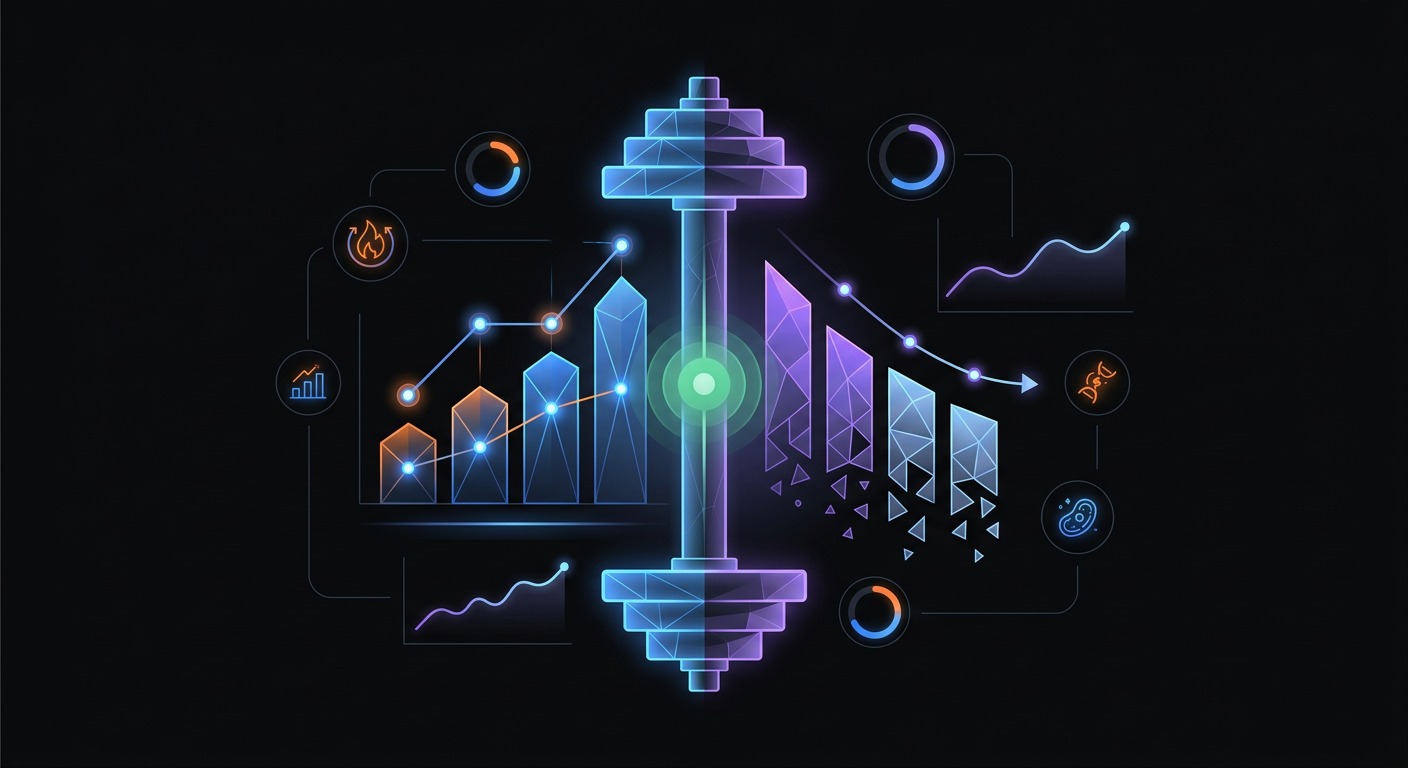
Body recomposition (recomp) is the simultaneous gain of lean muscle mass and loss of body fat. Your scale weight might not change at all, but your body composition shifts — less fat, more muscle, different shape.
This is fundamentally different from the traditional bulk-and-cut cycle, where you alternate between:
| Approach | Goal | Typical Duration |
|---|---|---|
| Bulking | Maximize muscle gain (accept some fat) | 3–6 months |
| Cutting | Maximize fat loss (preserve muscle) | 2–4 months |
| Recomp | Build muscle and lose fat simultaneously | Ongoing |
The trade-off? Recomp is slower than a dedicated bulk or cut for each individual goal. But for the right person in the right situation, it's the most efficient path to looking and performing better.
The Evidence: It Actually Works
Body recomposition isn't just bro-science optimism. A review by Barakat et al. (2020) published in the NSCA's Strength and Conditioning Journal examined the literature and concluded that body recomposition is achievable — even in trained individuals — when training and nutrition are properly managed.
One of the most compelling studies comes from Longland et al. (2016), published in the American Journal of Clinical Nutrition. Participants in a caloric deficit who consumed 2.4 g/kg of protein daily while performing intense resistance training gained 1.2 kg of lean body mass while losing significantly more fat than a lower-protein group. They were in a deficit the entire time.
This isn't an isolated finding. Multiple studies have demonstrated body recomposition under the right conditions. The question isn't if it's possible — it's for whom and how.
Who Can Achieve Body Recomp?
Not everyone will have the same success with body recomposition. Your results depend heavily on where you're starting from.
Tier 1: Best Candidates
These groups have the highest likelihood of meaningful body recomp:
- Beginners (< 1 year of serious training) — New lifters experience rapid "newbie gains" because their muscles are highly sensitive to the training stimulus. Even in a modest deficit, they can build significant muscle.
- Detrained lifters returning to training — If you've taken months or years off, muscle memory is real. Previously trained muscle regrows faster than building new muscle from scratch.
- Overweight/obese individuals — Higher body fat provides a large energy reserve. The body can partition nutrients toward muscle growth while pulling from fat stores for energy.
Tier 2: Possible but Slower
- Intermediate lifters (1–3 years) — Recomp is still possible but the rate of muscle gain slows as you advance. Expect subtle changes over months, not weeks.
- Lifters at moderate body fat (15–25%) — Enough stored energy to support partitioning, but the effect is less dramatic than in higher body fat individuals.
Tier 3: Difficult
- Advanced lifters (3+ years, close to genetic potential) — Muscle gain is already extremely slow. A dedicated bulk is almost always more effective.
- Lean individuals (< 12% body fat) — Low body fat means less energy available for muscle building. The body prioritizes survival over muscle growth in a deficit.
If you're an intermediate lifter with 15–20% body fat who trains consistently, body recomp is a realistic goal. You won't gain muscle as fast as a dedicated bulk, but you'll look better month-over-month without the uncomfortable fat gain.
The Three Pillars of Body Recomp
Body recomposition requires getting three things right simultaneously. Miss any one, and the whole process stalls.
Pillar 1: High Protein Intake
Protein is the single most important nutritional variable for body recomp. A meta-analysis by Morton et al. (2018) analyzing 49 studies found that protein supplementation significantly enhances resistance-training-induced gains in lean mass, with diminishing returns beyond approximately 1.6 g/kg/day.
However, during a caloric deficit, protein needs increase. The Longland study mentioned earlier used 2.4 g/kg — well above the typical recommendation — and produced significantly better results.
Practical protein targets for recomp:
| Body Weight | Minimum (1.6 g/kg) | Optimal (2.0–2.4 g/kg) |
|---|---|---|
| 150 lbs (68 kg) | 109 g/day | 136–163 g/day |
| 175 lbs (80 kg) | 128 g/day | 160–192 g/day |
| 200 lbs (91 kg) | 146 g/day | 182–218 g/day |
Tracking protein is non-negotiable during a recomp. Iridium's nutrition tracking makes this straightforward — log meals via barcode scan, photo AI, or text search against a database of 3.9+ million foods. Set a protein target and monitor your daily intake without the guesswork.
Build every meal around protein. If you're struggling to hit 2 g/kg, prioritize protein-dense foods (chicken, fish, Greek yogurt, whey) and log them before filling in carbs and fats.
Pillar 2: Resistance Training Stimulus
Your body has no reason to build (or even maintain) muscle unless you give it a strong signal to do so. During a deficit, that signal needs to be even stronger than usual.
Key training principles for recomp:
-
Prioritize progressive overload — Continue pushing for strength gains even during a deficit. This is the strongest signal to your body that it needs muscle. Check out our progressive overload guide if you need a refresher.
-
Maintain training volume — Don't slash volume just because you're in a deficit. A dose-response relationship exists between volume and hypertrophy (Schoenfeld et al., 2017). Aim to maintain your current volume within the MEV–MAV range for each muscle group.
-
Train each muscle 2x per week minimum — Training frequency matters for growth (Schoenfeld et al., 2016). Hit each muscle group at least twice per week, even during a deficit.
-
Keep training intensity high — RPE 7–9 on working sets. The muscles need to be challenged. Don't coast just because you're eating less.
Iridium tracks your volume per muscle group against your MEV/MAV/MRV landmarks, so you can ensure you're maintaining enough training stimulus during a recomp — without accidentally overreaching while recovery is compromised.
Pillar 3: A Moderate Caloric Deficit
The size of your deficit matters enormously. Too aggressive, and you'll lose muscle. Too small, and fat loss stalls.
Garthe et al. (2011) compared slow weight loss (0.7% of body weight per week) to fast weight loss (1.4% per week) in elite athletes performing resistance training. The slow group actually gained lean body mass while losing fat. The fast group lost lean mass.
Deficit guidelines for recomp:
| Approach | Weekly Rate | Deficit Size | Best For |
|---|---|---|---|
| Conservative recomp | 0.25–0.5% BW/week | 200–400 cal/day | Intermediate lifters, lean individuals |
| Moderate deficit | 0.5–0.75% BW/week | 400–600 cal/day | Beginners, overweight individuals |
| Aggressive cut | 1%+ BW/week | 750+ cal/day | Fat loss priority (recomp unlikely) |
For a 180 lb lifter, a conservative recomp deficit is about 300–500 calories below maintenance. That's small enough to preserve (and build) muscle while still losing roughly 0.5–1 lb of fat per week.
Crash diets kill body recomp. If you're eating 1,200 calories and wondering why you're losing muscle, this is why. Your body can't build tissue without adequate energy and protein. A smaller deficit, sustained over time, produces far better results.
Why the Scale Lies During Recomp
Here's where most people abandon recomp too early: the scale doesn't move.
If you're simultaneously gaining 1 lb of muscle and losing 1 lb of fat in a month, the scale reads the same number. But your body composition has changed meaningfully. This is why the scale is the worst tool for measuring recomp progress.
What actually changes during recomp:
- Your clothes fit differently (tighter in the shoulders, looser in the waist)
- Your lifts go up (muscle is being built)
- Visual changes in the mirror (more definition, less softness)
- Measurements shift (waist shrinks, arms/thighs grow or maintain)
Better Ways to Track Progress
| Method | What It Tells You | Frequency |
|---|---|---|
| Body measurements | Where you're gaining/losing | Every 2–4 weeks |
| Strength tracking | Whether muscle is being built | Every session |
| Progress photos | Visual changes over time | Every 2–4 weeks |
| Body fat % | Ratio of fat to lean mass | Monthly |
| Scale weight | Very little during recomp | Weekly (for trending only) |
Iridium lets you track body measurements — including waist, arms, thighs, body fat percentage, and muscle mass — with built-in measurement guides for consistency. Chart these over time alongside your strength progress (1RM estimates, volume trends) to get the full picture of your recomp.
During a recomp, your most valuable metrics are waist circumference (going down = fat loss), strength on key lifts (going up = muscle gain), and body measurements of target muscle groups. Iridium tracks all of these and charts your progress over time.
Realistic Timelines and Expectations
Body recomposition is a slow process. Setting realistic expectations is the difference between sticking with it and quitting.
Beginner (< 1 year training)
- Muscle gain: 1–2 lbs/month is realistic even in a moderate deficit
- Fat loss: 2–4 lbs/month at a conservative deficit
- Timeline to visible results: 2–3 months
- Scale impact: May stay flat or drop slowly
Intermediate (1–3 years training)
- Muscle gain: 0.5–1 lb/month
- Fat loss: 1.5–3 lbs/month at a conservative deficit
- Timeline to visible results: 3–6 months
- Scale impact: May drop slowly
Advanced (3+ years training)
- Muscle gain: Negligible in a deficit
- Recommendation: Dedicated bulk/cut cycles will be more effective
These numbers assume consistent training (3–5x/week), adequate protein (1.6–2.4 g/kg), sufficient sleep (7+ hours), and a moderate deficit. Miss any of these consistently and results will be significantly worse.
Putting It All Together: Your Recomp Plan
Here's a practical framework for implementing body recomposition:
Step 1: Set your calories. Find your maintenance (track intake for 1–2 weeks at stable weight), then subtract 300–500 calories.
Step 2: Set your protein. Aim for 2.0–2.4 g/kg of body weight daily. This is the most important macro target.
Step 3: Train hard. Follow a structured program hitting each muscle group 2x/week with progressive overload. Don't reduce volume because you're in a deficit.
Step 4: Track the right metrics. Measure your waist, key body parts, and key lifts every 2–4 weeks. Don't obsess over the scale.
Step 5: Be patient. Give it at least 8–12 weeks before evaluating. Recomp is a slow process, but the results are sustainable and impressive.
Iridium brings all of these together in one place — macro tracking to nail your protein and calorie targets, volume tracking to ensure your training stimulus stays high, strength and 1RM charts to confirm muscle is being built, and body measurements to verify that your composition is actually changing. Your Readiness Score also helps you gauge recovery during a deficit, which is critical when energy availability is lower.
The Bottom Line
Body recomposition is real, it's backed by research, and it's achievable for most lifters — especially beginners, detrained individuals, and anyone carrying extra body fat. The recipe is straightforward:
- High protein (2.0–2.4 g/kg/day)
- Hard resistance training (maintain volume and progressive overload)
- Moderate deficit (300–500 calories below maintenance)
- Patience (measure progress by body comp, not the scale)
Stop chasing the scale number. Start tracking what actually matters.
Track your recomp in Iridium. Log your macros, track strength gains, measure your body composition, and see the full picture of your progress — not just a number on a scale. Download Iridium free on the App Store. image: "/blog/body-recomposition-guide-hero.png"
Related Posts
Fasted Training: Pros, Cons, and Who It's For
Should you work out on an empty stomach? We break down the science of fasted training, its effects on fat loss and muscle, and practical tips.
Intermittent Fasting for Lifters: Does It Help or Hurt Gains?
Can you build muscle with intermittent fasting? The research on IF protocols, muscle growth, strength, and practical strategies for lifters.
Caffeine and Workout Performance: The Evidence-Based Guide
How caffeine improves strength, endurance, and focus. Optimal dosage, timing, tolerance management, and how to use caffeine before your workout.