GZCLP Explained: The Tiered Approach to LP
A complete guide to the GZCLP program. Learn the T1/T2/T3 tier system, linear progression scheme, exercise selection, and how to set it up.
Most beginner programs hand you a barbell and tell you to add weight every session until you can't. GZCLP does something smarter. It organizes your training into three tiers of priority, gives you a built-in plan for when you stall, and teaches you how to structure training like an experienced lifter — from day one.
Here's how the GZCLP program works and how to set it up properly.
What Is GZCLP?
GZCLP is the linear progression (LP) version of the GZCL methodology, created by powerlifter and coach Cody LeFever. The name comes from his Reddit handle (/u/gzcl), and the "LP" stands for linear progression — meaning you add weight every session.
The GZCL method is built around a simple principle: not all exercises deserve equal attention. Your training should be organized into tiers based on priority and intensity. The heaviest, most important lifts get the most focus and the lowest reps. Supporting exercises fill in the gaps with more volume.
GZCLP takes this methodology and packages it into a straightforward program that beginners and early intermediates can run out of the box.
The Tier System: T1, T2, T3
This is the core concept that makes GZCL different from other beginner programs. Every exercise in your workout falls into one of three tiers:
| Tier | Purpose | Rep Range | Intensity | Example |
|---|---|---|---|---|
| T1 | Primary strength | 3–5 reps | Heavy (85–95%) | Squat, Bench, Deadlift, OHP |
| T2 | Secondary strength/volume | 8–10 reps | Moderate (65–80%) | Front Squat, Close-Grip Bench, RDL |
| T3 | Assistance/isolation | 15–25 reps | Light (50–65%) | Lat Pulldown, Curls, Face Pulls |
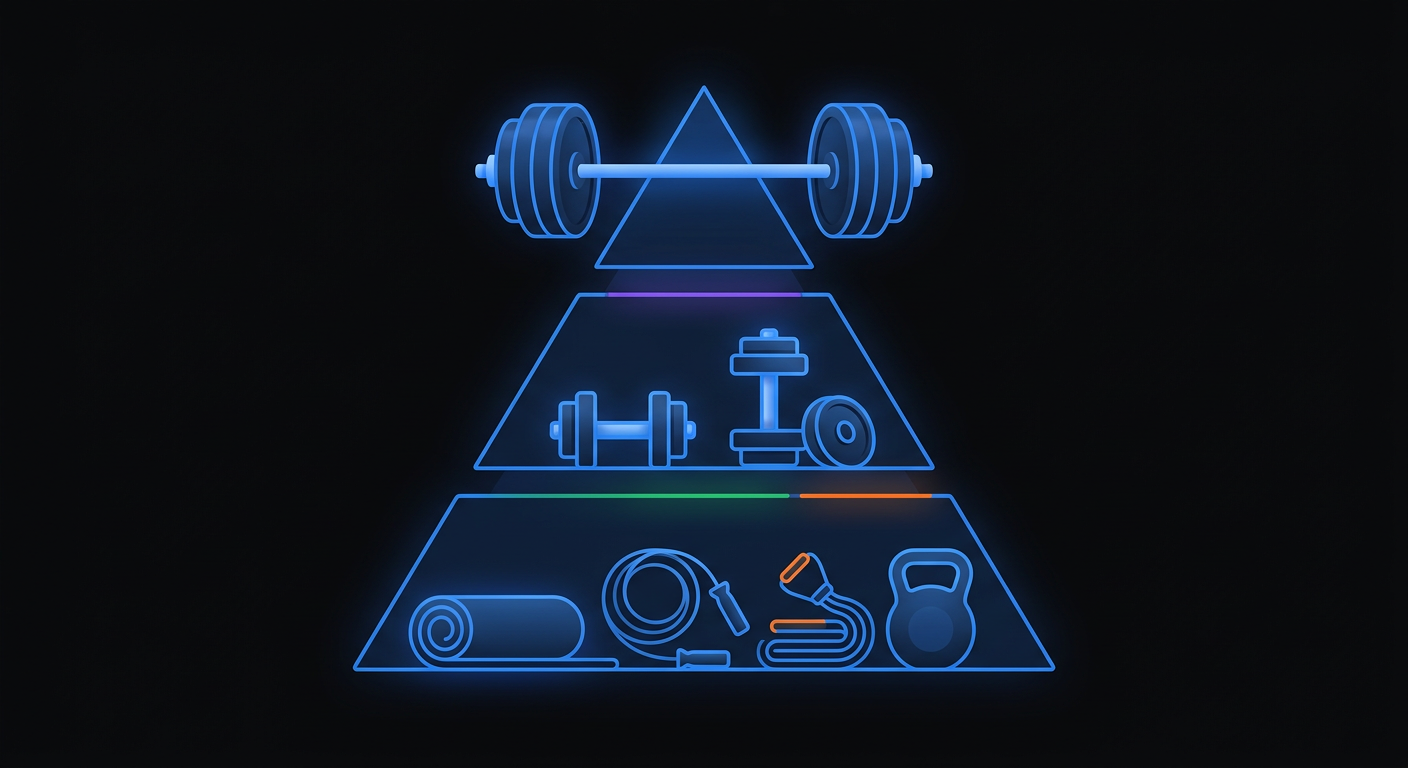
Think of it as a pyramid. The T1 lift at the top is the most important exercise of the day — it gets the heaviest weight and the most rest. T2 supports the T1 with moderate-intensity compound work. T3 rounds out the session with lighter isolation work to address weak points and accumulate volume.
This tiered approach aligns with what research tells us about training adaptations. Heavier loads produce superior maximal strength gains, while lighter loads can produce comparable hypertrophy when taken close to failure (Schoenfeld et al., 2017). GZCLP uses both ends of the spectrum in a single session.
Imagine an inverted pyramid of volume: T1 has the least total reps but the highest intensity. T3 has the most total reps but the lowest intensity. T2 sits in the middle. This structure ensures you're fresh for the heaviest, most technically demanding work.
The GZCLP 4-Day Program
GZCLP runs on a 4-day rotation. Each day has one T1 lift, one T2 lift, and one or more T3 lifts.
Day A1
| Tier | Exercise | Sets × Reps |
|---|---|---|
| T1 | Squat | 5 × 3 |
| T2 | Bench Press | 3 × 10 |
| T3 | Lat Pulldown | 3 × 15+ |
Day B1
| Tier | Exercise | Sets × Reps |
|---|---|---|
| T1 | Overhead Press | 5 × 3 |
| T2 | Deadlift | 3 × 10 |
| T3 | Dumbbell Row | 3 × 15+ |
Day A2
| Tier | Exercise | Sets × Reps |
|---|---|---|
| T1 | Bench Press | 5 × 3 |
| T2 | Squat | 3 × 10 |
| T3 | Lat Pulldown | 3 × 15+ |
Day B2
| Tier | Exercise | Sets × Reps |
|---|---|---|
| T1 | Deadlift | 5 × 3 |
| T2 | Overhead Press | 3 × 10 |
| T3 | Dumbbell Row | 3 × 15+ |
You alternate between A and B days. If you train Mon/Wed/Fri, week one is A1/B1/A2, week two is B2/A1/B1, and so on. Each main lift appears as a T1 (heavy) and a T2 (moderate volume) every rotation, which means you're hitting each lift pattern twice across the four sessions.
Iridium's workout template system is a natural fit for GZCLP. Create four templates (A1, B1, A2, B2) and use a rolling weekly schedule to cycle through them in order. With AI-Enhanced Targets enabled, Iridium will automatically adjust your weight targets based on your logged performance — so when you hit your reps, the next session's targets go up.
How Progression Works
This is where GZCLP really shines. Instead of just saying "add weight until you can't," it gives you a structured plan for what to do when you stall.
T1 Progression
- Start: 5 sets × 3 reps. Add weight each session (5 lbs upper, 10 lbs lower).
- First stall: When you fail to complete 5 × 3, switch to 6 sets × 2 reps at the same weight.
- Second stall: When you fail 6 × 2, switch to 10 sets × 1 rep.
- Third stall: When you fail 10 × 1, test a new 1RM or 5RM, then reset to 85% and restart at 5 × 3.
T2 Progression
- Start: 3 sets × 10 reps. Add weight each session.
- First stall: When you fail 3 × 10, switch to 3 sets × 8 reps.
- Second stall: When you fail 3 × 8, switch to 3 sets × 6 reps.
- Third stall: Reset to 85% and restart at 3 × 10.
T3 Progression
T3 exercises use a simple AMRAP (as many reps as possible) approach:
- Perform 3 sets × 15+ reps. The last set is AMRAP.
- When you can complete 25+ reps on the AMRAP set, add weight next session.
This built-in failure protocol is what separates GZCLP from programs like StrongLifts or Starting Strength. Instead of deloading and trying the same thing again, you shift to a different rep scheme that lets you keep progressing with the same weight before eventually resetting. Research supports this flexibility — both load progression and repetition progression produce comparable strength and hypertrophy adaptations (Plotkin et al., 2022).
The stall-and-shift system means you'll spend more time progressing before needing a full reset. Most beginners can run GZCLP for 4–6 months before exhausting the progression scheme on their main lifts.
Who Should Run GZCLP?
Ideal for:
- True beginners who want more structure than "just add weight"
- Late beginners or early intermediates who've stalled on simpler LPs
- Lifters who want to learn the GZCL methodology before moving to more advanced GZCL variants
- Anyone who appreciates a clear plan for handling plateaus
Not ideal for:
- Advanced lifters who need periodized programming
- Lifters primarily focused on hypertrophy with no strength goals — a higher-volume program may be a better fit
- People who train fewer than 3 days per week
If you're not sure whether you still qualify as a beginner, here's a simple test: can you add weight to the bar every session? If yes, you're still a beginner and GZCLP is perfect. If not, you may need to look at intermediate programming that uses weekly or monthly progression.
Adding T3 Exercises
The base GZCLP template is intentionally minimal. Once you're comfortable with the program (2–4 weeks in), add T3 exercises to address weak points and build more muscle.
Good T3 additions:
| Muscle Group | T3 Options |
|---|---|
| Back | Face Pulls, Cable Rows, Rear Delt Flies |
| Arms | Barbell Curls, Tricep Pushdowns, Hammer Curls |
| Legs | Leg Curls, Leg Extensions, Calf Raises |
| Core | Cable Crunches, Hanging Leg Raises, Planks |
| Shoulders | Lateral Raises, Reverse Flies |
Add 1–2 T3 exercises per session, not more. Keep them at 3 × 15+ with the AMRAP progression. T3 work should take 10–15 minutes max — it's assistance, not the main event.
Tracking the total volume from your T3 work matters more than most beginners realize. As you add exercises, your weekly set count per muscle group climbs. Knowing where you sit relative to your volume landmarks — MEV, MAV, and MRV — helps you add T3 work strategically rather than randomly. Iridium tracks sets per muscle group automatically and shows you whether you're in the productive growth zone or creeping toward overtraining.
Setting Up GZCLP: Step by Step
-
Find your starting weights. For T1 lifts, use a weight you can comfortably do for 5 × 3 with 2–3 reps in reserve. This is usually around 80–85% of your current 5RM. Start lighter than you think — you'll progress quickly.
-
Set up your four workouts. Organize each day with the T1/T2/T3 structure from the tables above. Add 1–2 extra T3 exercises if you want.
-
Track every session. Log your weights, reps, and RPE for each set. This data is what drives your progression decisions.
-
Follow the progression scheme. Add weight when you complete all prescribed reps. When you stall, shift to the next rep scheme — don't just deload and retry.
-
Know when to move on. Once you've cycled through all three T1 rep schemes and reset 2–3 times, you've likely outgrown linear progression. Time to look at an intermediate GZCL template or another periodized program.
The total number of sets to failure or near failure is what drives hypertrophy adaptations, as long as you're working in a reasonable rep range (Baz-Valle et al., 2021). GZCLP's tier system ensures you're accumulating productive volume across all rep ranges — heavy work for strength, moderate work for general development, and high-rep work for isolation and weak points.
Common GZCLP Mistakes
1. Starting too heavy. The most common mistake. If your first T1 session feels like a grind, you started too heavy. Drop the weight. You'll be back there in 2–3 weeks with better technique.
2. Skipping T3 entirely. The base program works, but T3 exercises are what round out your physique and protect your joints. Add them after the first couple of weeks.
3. Not tracking the progression scheme. GZCLP's strength is its structured stall protocol. If you're not recording which rep scheme you're on for each lift, you'll lose track and miss the point of the program.
4. Ignoring recovery. Linear progression demands consistent recovery. If you're not sleeping enough, undereating, or stacking life stress on top of training stress, no progression scheme can save you.
Don't modify the T1 and T2 exercise selection unless you have a specific reason (injury, equipment limitation). Squat, bench, deadlift, and overhead press are the T1 lifts for a reason — they provide the most strength stimulus per exercise.
GZCLP vs. Other Beginner Programs
| Feature | GZCLP | StrongLifts 5×5 | Starting Strength |
|---|---|---|---|
| Days per week | 3–4 | 3 | 3 |
| Tier system | Yes (T1/T2/T3) | No | No |
| Stall protocol | Built-in (3 phases) | Deload and retry | Deload and retry |
| Isolation work | Yes (T3) | None | Minimal |
| Upper body pressing | Bench + OHP | Bench + OHP | Bench + OHP |
| Customizability | High (T3 selection) | Low | Low |
GZCLP's main advantage: it teaches you how to think about training structure. The tier system is a framework you'll use for years, not just during this program.
Start Running GZCLP
GZCLP is one of the best-designed beginner programs available. The tier system teaches you training hierarchy, the built-in stall protocol keeps you progressing longer, and the T3 flexibility lets you customize the program to your goals.
Whether you're picking up a barbell for the first time or you've stalled on a simpler LP, GZCLP gives you a clear path forward with real structure behind it.
Ready to get started? Download Iridium and build your GZCLP templates with AI-Enhanced Targets. Track your progressive overload across all three tiers, log your RPE, and let PR detection tell you when you've hit a new max. The tier system is the strategy — Iridium is the tool that keeps it all on track. image: "/blog/gzclp-explained-hero.png"
Related Posts
Starting Strength Review: Is Rippetoe's Program Worth It?
An honest review of the Starting Strength program. We break down the 3x5 structure, lifts, progression, pros, cons, and who it's best for.
StrongLifts 5x5 Review: Simple, Effective, but Limited
An honest StrongLifts 5x5 review covering the A/B structure, progression scheme, pros, cons, and how it compares to modern training tools.
nSuns Program: The Complete LP Guide
Complete guide to the nSuns 531 LP program. Covers the progression scheme, training max system, accessory work, and who this program is best for.