How to Choose an AI Workout App: What Actually Matters
Not all AI fitness apps are created equal. Learn what features to look for, what to avoid, and how to pick an AI workout app that actually helps you progress.
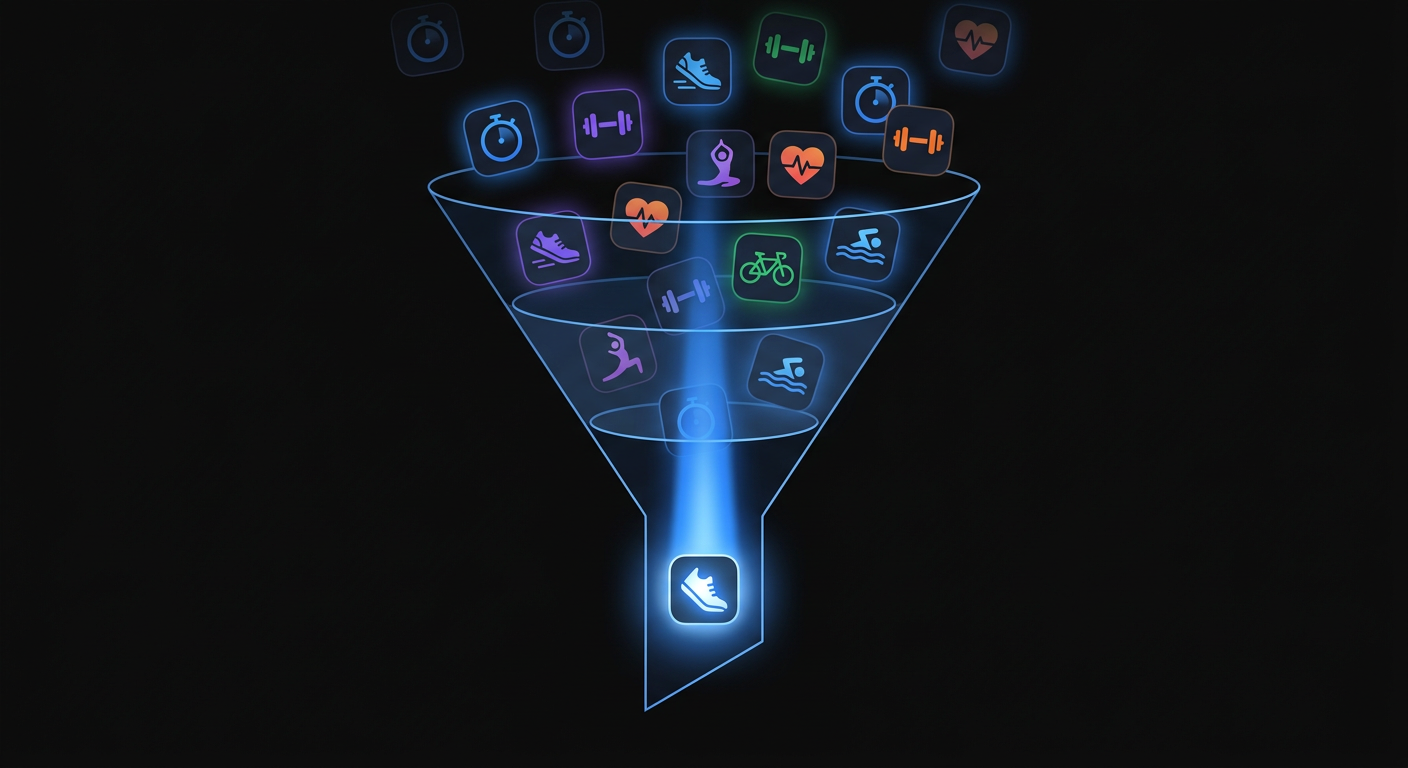
The fitness app market is flooded with "AI-powered" workout apps. Every app claims to use artificial intelligence to personalize your training. But there's a massive gap between marketing buzzwords and genuinely useful AI.
Most "AI" workout apps are just randomizers with fancy branding. They shuffle exercises, pick arbitrary rep ranges, and call it personalization. Real AI-driven training adapts to your actual performance, learns your recovery patterns, and makes intelligent decisions about when to push and when to pull back.
Here's how to separate the real from the fake — and find an AI workout app that actually helps you build muscle and strength.
What "AI" Actually Means in Fitness Apps
Before diving into features, let's clarify what AI should do in a workout app.
Real AI features:
- Learns from your training history to predict optimal weights and volumes
- Adjusts programming based on your actual performance, not arbitrary schedules
- Tracks recovery across muscle groups and modifies training accordingly
- Uses evidence-based algorithms grounded in sports science research
Fake AI features (marketing buzzwords):
- Random exercise selection presented as "personalization"
- Pre-built templates that ignore your actual progress
- Generic recommendations that don't adapt to individual responses
- "Smart" features that are just basic conditional logic
The difference matters. A truly intelligent app should get smarter as you use it. If your app gives the same recommendations after 6 months as it did on day one, it's not learning anything.
Iridium uses progressive learning — the AI analyzes your training history, tracks per-muscle fatigue and recovery, and adjusts every workout based on what your body actually needs. Not templates. Not guesswork. Real adaptation.
Essential Features to Look For
1. Progressive Overload Tracking
This is non-negotiable. Any app worth using must track your weights, reps, and sets over time — and help you progressively increase them.
Research consistently shows that progressive overload is the primary driver of strength and muscle gains. A meta-analysis by Schoenfeld et al., 2017 found that training volume (sets × reps × weight over time) is the key determinant of hypertrophy.
What to look for:
- Automatic weight suggestions based on your history
- Clear visualization of progress over time
- Alerts when you've stalled on key lifts
Red flags:
- Apps that don't track weights at all
- No history or progress charts
- Manual-only logging with no intelligence layer
2. Volume Management Per Muscle Group
Your chest can handle different volume than your biceps. Your quads recover at different rates than your shoulders. Good AI accounts for this.
The concept of Maximum Recoverable Volume (MRV) varies by muscle group and individual. An intelligent app should track volume per muscle group — not just total sets — and adjust based on your recovery capacity.
What to look for:
- Per-muscle volume tracking (not just total workout volume)
- Fatigue indicators showing when muscles need more rest
- Automatic volume adjustments across training blocks
Red flags:
- Apps that only count "total sets" without muscle-group breakdown
- No concept of accumulated fatigue
- Same volume recommendations regardless of individual response
3. Exercise Substitution Intelligence
Life happens. Gyms get crowded. Equipment breaks. You travel.
A good AI app understands exercise substitution — when you can't do barbell bench press, it knows dumbbell bench or machine press hit similar muscles. It doesn't just leave you stranded or suggest random replacements.
What to look for:
- Smart alternatives based on muscle activation, not just movement pattern
- Equipment-aware programming (home gym vs commercial gym)
- Ability to specify available equipment and get complete workouts
Red flags:
- Rigid programs that break when equipment isn't available
- Random exercise swaps that don't match the training stimulus
- No consideration for gym setup or equipment constraints
4. Recovery and Readiness Tracking
Training is only half the equation. Recovery determines whether you can actually use the stimulus you created.
Schoenfeld et al., 2016 found that training frequency matters — but only if you've recovered enough to train productively. An AI app should factor recovery into its recommendations.
What to look for:
- Integration with sleep and health data (Apple Health, etc.)
- Per-muscle recovery status indicators
- Deload recommendations when fatigue accumulates
- Adjustments based on life stress, sleep quality, soreness
Red flags:
- Apps that ignore recovery entirely
- No integration with health data
- Same intensity recommendations regardless of readiness
5. Evidence-Based Programming
The best AI is built on sports science, not bro science. Look for apps that cite research, use established training principles, and avoid pseudoscientific claims.
Principles like progressive overload, volume periodization, and frequency optimization aren't opinions — they're backed by decades of research. Your app should reflect this.
What to look for:
- Training methodology grounded in research
- Transparent about how recommendations are generated
- Avoids extreme or unsupported claims
Red flags:
- "Revolutionary" training methods with no scientific backing
- Vague explanations of how the AI works
- Programs that contradict established exercise science
Features That Look Cool But Don't Matter Much
Real-Time Form Feedback (via Camera)
Some apps use your phone camera to analyze form. In theory, this sounds amazing. In practice, it's usually more gimmick than useful.
Camera-based form analysis requires specific angles, good lighting, and movements that work within the camera's view. For most exercises in most gyms, it's impractical. You're better off recording yourself occasionally and reviewing the footage.
Gamification and Streaks
Badges, streaks, and achievements can be motivating for some people. But they don't make you stronger. If an app emphasizes gamification over actual training quality, it's prioritizing engagement metrics over your results.
Consistency matters, but a 100-day streak of mediocre workouts isn't better than 50 days of intelligent training with appropriate rest.
Social Features
Training with friends can be motivating. But social features in workout apps often become distractions rather than enhancements. If you want community, find a gym buddy or join a fitness community. Your AI workout app should focus on making you stronger.
What to Avoid
Subscription Traps
Some apps offer free trials that require credit cards, then make cancellation difficult. Others paywall basic features that should be standard (like tracking your own workouts).
Look for: Transparent pricing, easy cancellation, reasonable free tier for basic functionality.
Data Hostage Situations
Your training data is valuable. You've spent months or years logging workouts. Some apps make it nearly impossible to export your data, locking you into their ecosystem.
Look for: Export functionality, data portability, ownership of your own training history.
Overcomplicated Interfaces
If you spend more time navigating the app than training, something is wrong. The best workout apps are intuitive — you should be able to log a set in seconds, not minutes.
Look for: Clean interface, fast logging, minimal friction between you and your workout.
Comparing AI Workout Apps: Key Questions
When evaluating any AI fitness app, ask these questions:
-
How does it learn? Does the AI actually adapt based on your performance, or is it just shuffling pre-built templates?
-
What data does it track? Per-muscle volume? Recovery? Progressive overload? Or just basic sets and reps?
-
Is the methodology sound? Is the programming grounded in sports science, or is it proprietary "magic"?
-
Can you export your data? If you leave, can you take your training history with you?
-
How's the logging experience? Is it fast and intuitive, or clunky and frustrating?
-
What's the pricing model? Transparent subscription? Hidden fees? Features paywalled arbitrarily?
The Bottom Line
Not all AI workout apps deliver on their promises. Many use "AI" as a marketing term while offering little more than randomized workouts and basic tracking.
The best AI fitness apps learn from your actual training data, manage volume intelligently across muscle groups, track recovery, and program based on evidence-based principles. They make logging fast, provide genuine insights, and help you progress systematically rather than randomly.
Before committing to any app, use the free trial critically. Track whether it actually adapts to your performance. Notice if the recommendations get smarter over time. If after a few weeks it's still giving generic suggestions, it's not learning — and you deserve better.
Your training data is valuable. Your time is limited. Choose an AI workout app that respects both.
Built for Intelligent Training
Iridium was built by lifters who got tired of apps that promised AI and delivered randomness. The app tracks per-muscle volume, monitors recovery, integrates with Apple Health, and adapts every workout based on your actual performance. It's the AI workout app that actually learns — and actually helps you get stronger. image: "/blog/how-to-choose-ai-workout-app-hero.png"
Related Posts
Autoregulation: How to Train by Feel Without Wasting Effort
Master autoregulation training using RPE and RIR methods. Learn when to push harder, when to pull back, and how training by feel produces better results.
How AI Workout Apps Actually Work
How AI workout apps generate personalized workouts, adapt to your progress in real time, and what separates smart AI fitness from glorified randomizers.
How to Break Through Training Plateaus
Stuck at the same weights for weeks? Here's the science of why plateaus happen and proven strategies to break through and start progressing again.