How AI Workout Apps Actually Work
How AI workout apps generate personalized workouts, adapt to your progress in real time, and what separates smart AI fitness from glorified randomizers.
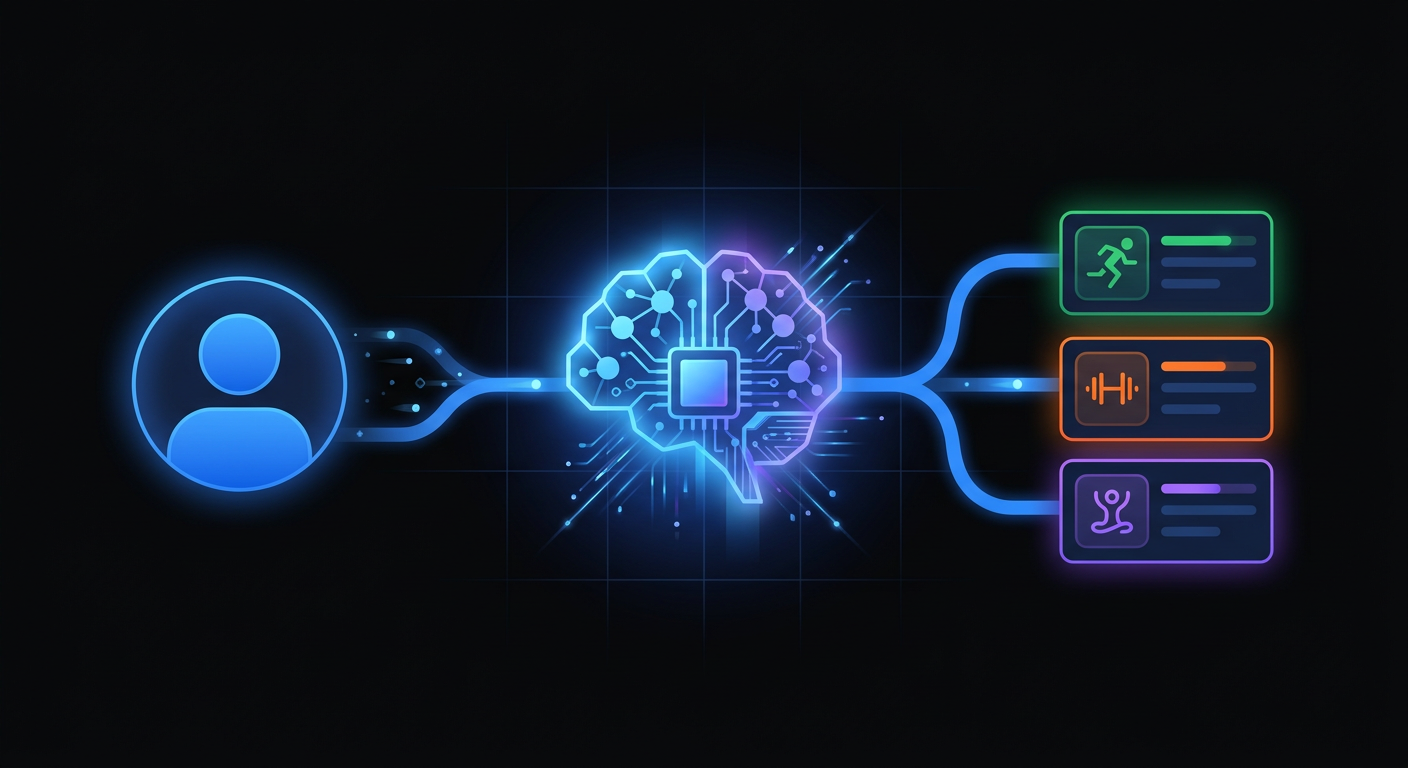
You tap "Generate Workout" and a few seconds later, a fully structured training session appears — exercises selected, sets and reps prescribed, weights assigned, rest periods configured. It feels seamless. But what's actually happening between that tap and the finished workout?
Most AI workout apps are complete black boxes. You put in some preferences, something comes out, and whether that "something" is genuinely intelligent or a glorified random generator is anyone's guess. Here's how the good ones actually work — and why the difference matters for your results. We'll walk through the complete pipeline: what data goes in, what the algorithms do with it, how the best systems learn from your training over time, and what separates the genuinely smart from the merely marketed.
Why Personalization Actually Matters
Before we get into algorithms, the foundational question: does personalization even matter that much?
Enormously. In a study of 53 men performing the same progressive resistance training program, strength gains ranged from -1% to +52% (Erskine et al., 2010). Same program, same exercises, same progression scheme — wildly different outcomes.
One person gained over 50% in strength while another made literally zero progress on the identical routine. This isn't a minor variance. It means a program that produces great results for your training partner might do nothing for you.
That's the entire case for intelligent personalization — and it's why a genuinely smart AI workout app is fundamentally different from a static program, no matter how well that program is designed.
The Input Layer: What the AI Actually Knows About You
Every AI workout app starts with data. The quality and breadth of that data determines how smart the output can be.
Your Profile
The basics: training goal (strength, hypertrophy, general fitness), experience level, available equipment, preferred training split, workout duration. This is the layer where most apps stop — and it's the least interesting part of the stack.
Your Training History
This is where it gets real. Every set you've ever logged feeds the model:
- Per-exercise performance trends — your estimated 1RM over time, rep ranges you respond best to, and how much weight you can handle at given intensities
- Volume patterns — how many sets per muscle group you've been doing, and how you respond to different volume levels relative to evidence-based landmarks like MEV, MAV, and MRV
- Exercise exposure — what you've done recently, what you haven't touched in a while, and which movements correlate with your best progress
Recovery Signals
Sleep duration, heart rate variability, resting heart rate, and per-muscle fatigue levels all inform how hard the AI should push you on a given day. If you got four hours of sleep and your HRV is in the gutter, a good system recognizes that today's workout needs to look different from what was originally planned.
For a deeper look at why recovery data matters so much for programming, our guide to muscle recovery tracking breaks down the science.
Contextual Factors
The best systems go beyond the obvious. Iridium, for example, factors in your gym's specific equipment inventory (down to maximum dumbbell weight), weather and air quality for outdoor exercises, free-text custom instructions you've written (like "I prefer barbell movements over machines" or "keep workouts under 50 minutes"), and the AI's memory of past conversations — so if you mentioned a nagging shoulder issue two weeks ago, it still remembers when building today's session.
This isn't feature bloat. Each additional signal narrows the gap between "roughly appropriate for someone like you" and "built for you, today."
The Algorithm: How AI Turns Data Into a Workout
With inputs gathered, the AI makes a series of interconnected decisions. Here's the general process most good systems follow:
Step 1: Determine What Needs Training
Based on your schedule, split, recovery status, and training history, the AI identifies which muscle groups to target. This isn't just "it's Monday, so chest." It's evaluating per-muscle fatigue levels, when you last trained each group, and your weekly volume targets relative to evidence-based volume landmarks.
Step 2: Select Exercises
With target muscles identified, the AI picks exercises from the available pool — constrained by your equipment, filtered by your preferences, and weighted by what's worked for you historically. Good systems balance familiarity (you need to practice the lifts you want to improve) with variety (avoiding staleness and hitting muscles from different angles).
Step 3: Prescribe Volume, Load, and Intensity
For each exercise, the AI assigns:
- Sets — based on your volume targets and how many exercises are already hitting the same muscle group
- Reps — based on your training goal and exercise type (heavy compounds get lower reps, isolation work gets higher)
- Weight — based on your performance history and estimated 1RM, adjusted for today's readiness
- RPE targets — how hard each set should feel, calibrated to your current fatigue level
Step 4: Structure the Session
Exercises get organized into a coherent session — compound movements first, logical pairings for supersets or circuits if you use them, appropriate rest periods between sets, and warmup sets scaled to the working weight.
Each step depends on the quality of the previous steps. Bad muscle targeting leads to bad exercise selection leads to bad volume prescription. This is why the data layer matters so much — garbage in, garbage out applies to AI fitness like anything else.
The Adaptation Loop: How Good AI Gets Smarter
Generating a single decent workout is useful. What makes AI genuinely powerful is the feedback loop — the system improving over time based on your actual results.
Within a Single Workout
The best systems don't just generate a plan and walk away. They adapt mid-session. When you log a set that was easier or harder than expected, the AI adjusts the remaining sets accordingly.
Say the AI prescribed 185 lbs for 8 reps at RPE 8 on bench press, but you crushed it at RPE 6. A static program doesn't care — your next set is whatever was written down. An adaptive system bumps up the weight or reps for remaining sets, keeping you in the productive training zone.
Iridium's real-time set analysis works exactly this way: after each completed set, the AI reviews your performance against the targets and recalibrates remaining sets based on your training methodology. You can have adjustments applied automatically or review them first — either way, you're not wasting sets because the original prescription was off.
Between Workouts
Each completed session feeds back into the model. The AI updates your estimated 1RMs, refines its understanding of your volume tolerance, and notes how exercises felt relative to targets. Over weeks and months, this compounds — exercise selection, load prescription, and volume recommendations all become more accurate with every logged set.
Research supports this approach directly. In a randomized clinical trial, participants receiving adaptively personalized recommendations from a reinforcement learning algorithm increased daily physical activity by 19%, while control groups saw near-zero change (Aguilera et al., 2024). The adaptive component — not just the technology itself — drove the improvement.
Over Weeks and Months
At the macro level, the AI builds a model of your individual training response. If your chest responds well to higher frequency, the AI starts programming more chest sessions per week. If your squat progress stalls above 16 weekly sets of quad work, volume gets capped there. These long-term patterns are invisible to most lifters managing their own programming — and even experienced coaches need months of observation to identify them.
Good vs. Bad: What to Look for in an AI Workout App
Not all AI is created equal. Here's how to tell the difference at a glance:
| Feature | Bad AI | Good AI |
|---|---|---|
| Data inputs | Goal + experience level | Full training history, recovery, equipment, preferences |
| Exercise selection | Random from a category | Based on your performance data and available equipment |
| Load prescription | Generic percentages | Your actual estimated 1RM adjusted for daily readiness |
| Adaptation | Same logic every time | Learns from your performance trends |
| Recovery awareness | Ignores it | Factors in sleep, HRV, muscle fatigue |
| Mid-workout adjustments | None | Real-time recalibration based on set performance |
The gap between these tiers isn't just about single-session accuracy — it's about what happens over months. A bad AI gives you a different random workout every day. A mediocre AI gives you something roughly appropriate. A good AI gives you a workout that's meaningfully better than what you'd program yourself — and that advantage, compounded across hundreds of sessions, is the difference between spinning your wheels and actually progressing.
A critical evaluation of AI-generated exercise prescriptions found that while general-purpose AI could produce safe, reasonable workout structures, it "lacked precision in addressing individual health conditions and goals" and tended toward excessive caution over training effectiveness (Dergaa et al., 2024). Generic AI can write a workout. It takes purpose-built systems with your actual training data to write your workout.
If an AI workout app generates your first workout without asking about your equipment, training history, or recovery — it's a template generator with a marketing budget. Real personalization requires real data.
Where AI Fitness Is Heading
We're still in the early stages. Current AI workout apps handle exercise selection, volume optimization, and recovery-based adjustments well. The next wave will likely include:
- Deeper biometric integration — continuous glucose monitoring, stress biomarkers, and more granular sleep staging feeding directly into workout adjustments
- Computer vision for form analysis — your phone camera providing real-time feedback on lifting technique
- Predictive injury prevention — identifying fatigue accumulation patterns that historically precede injuries before they happen
- Smarter long-term periodization — AI managing mesocycle and macrocycle planning, not just individual sessions
The fundamentals don't change — progressive overload still drives adaptation, recovery still matters, consistency still wins. What changes is how precisely you can dial in the variables. And that precision compounds over months and years of training.
Start Training Smarter
If you're still following a static program that doesn't know how you slept last night or how your last session actually went, there's a better way.
Download Iridium and see what happens when your AI actually knows what it's doing. image: "/blog/how-ai-workout-apps-work-hero.png"
Related Posts
Apple Watch Workout Tracking: A Lifter's Guide
How to use your Apple Watch for strength training. Key metrics, best practices, and the apps that turn your watch into a serious gym tool.
How to Choose an AI Workout App: What Actually Matters
Not all AI fitness apps are created equal. Learn what features to look for, what to avoid, and how to pick an AI workout app that actually helps you progress.
How AI Workout Apps Are Revolutionizing Strength Training (And Why Your Spreadsheet Can't Compete)
Discover how artificial intelligence is transforming workout programming, recovery optimization, and progressive overload. The future of strength training is here.