Hip Lift March
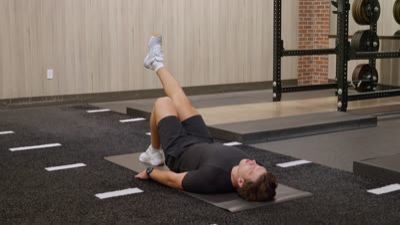
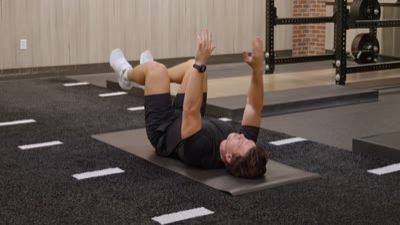
The Hip Lift March is a dynamic bodyweight exercise that combines a glute bridge with an alternating leg march to target the posterior chain. It strengthens the glutes and hamstrings while challenging core stability and pelvic control.

Iridium utilizes this exercise to accumulate glute volume without significantly increasing your systemic fatigue score. As a bodyweight movement, the AI tracks your rep performance relative to your body weight to verify progressive overload over time. It is typically scheduled when per-muscle recovery data indicates your glutes can handle volume but your lower back requires lower intensity.
Form Cues
- Drive through your heels to lift your hips
- Squeeze your glutes tightly at the top position
- Brace your core to keep your pelvis level
- Exhale as you lift your knee toward your chest
- Place your foot back down softly and with control
- Don't let your hips dip when lifting a leg
- Don't arch your lower back excessively
- Don't allow your hips to rock side-to-side
- Don't rush the marching movement
- Don't push off your toes; keep weight in the heels
Common Mistakes
- Rotating the pelvis
- Hyperextending the lumbar spine
- Dropping hips during the march
- Relying on momentum
- Insufficient glute engagement
Muscles Worked
This exercise primarily strengthens the gluteus maximus and hamstrings through sustained isometric hip extension. It uniquely targets the core stabilizers, specifically the obliques and transverse abdominis, forcing them to work overtime to prevent your hips from dipping or rotating as you shift your weight between legs.
Primary
Secondary

Get Personalized Coaching for Hip Lift March
Don't guess your way through weights or workouts. Download Iridium for automatic, AI-powered coaching that adapts to your recovery and goals.