Stability Ball Plank
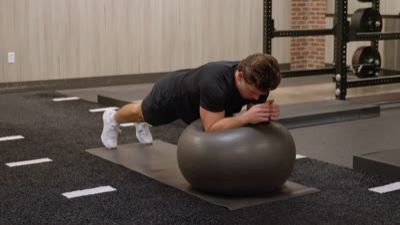
The Stability Ball Plank is an intermediate isometric core exercise that intensifies standard planking by introducing an unstable surface under your forearms. It primarily targets the deep transverse abdominis and shoulder stabilizers while challenging balance and full-body tension.

Since this movement places significant isometric load on the anterior deltoids as well as the core, Iridium checks your recent workout history to ensure your shoulders aren't already exhausted from heavy pressing. The AI progresses this exercise by comparing your hold times against RPE, increasing duration targets only when your perceived exertion confirms you can handle more volume without failure.
Form Cues
- Press your forearms firmly into the ball to protract your shoulder blades
- Squeeze your glutes and quads to create full-body tension
- Keep your elbows positioned directly under your shoulders
- Draw your navel in toward your spine to brace the core
- Don't let your hips sag toward the floor
- Don't hike your hips up into a pike position
- Don't rest your chest against the ball
- Don't let your shoulders shrug up toward your ears
Common Mistakes
- Lumbar hyperextension (swayback)
- Holding breath due to tension
- Looking forward instead of down
- Interlocking fingers tightly
Muscles Worked
This exercise deeply engages the transverse abdominis and rectus abdominis, forcing them to work harder to stabilize the torso against the moving ball. It also heavily recruits the anterior deltoids and serratus anterior for shoulder girdle stability, while the glutes and erector spinae work isometrically to maintain a neutral spine.
Primary
Secondary

Get Personalized Coaching for Stability Ball Plank
Don't guess your way through weights or workouts. Download Iridium for automatic, AI-powered coaching that adapts to your recovery and goals.