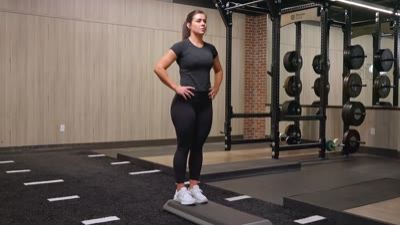
Bodyweight Step Up to Deficit Reverse Lunge
The Bodyweight Step Up to Deficit Reverse Lunge is a hybrid lower-body exercise that combines a step-up with a deep reverse lunge. This movement targets the quadriceps and glutes while significantly challenging balance, coordination, and single-leg stability.

Iridium classifies this as a high-coordination movement and checks your recovery score to ensure you have the energy to perform it effectively. The AI tracks your rep performance relative to your body weight to verify progressive overload, adjusting volume targets based on your RPE feedback. If your 7-day history suggests your lower body stabilizers are already fatigued, Iridium will swap this for a more stable alternative to ensure the target muscles receive adequate stimulus.
Form Cues
- Place your entire lead foot firmly on the box
- Drive through your front heel to stand tall
- Control the descent slowly into the reverse lunge
- Keep your torso upright and core engaged
- Allow your back knee to hover just above the floor
- Don't push off aggressively with your back foot
- Don't let your front knee collapse inward
- Don't slam your back knee into the ground
- Don't hunch your shoulders forward
- Don't let your front heel lift off the box
Common Mistakes
- Using momentum from the back leg
- Rushing the downward phase
- Excessive forward leaning
- Allowing the knee to cave inward
- Placing only the toes on the box
Muscles Worked
This exercise is a powerhouse for the quadriceps and glutes, utilizing a large range of motion to maximize muscle fiber recruitment. The deficit aspect increases the stretch on the glutes and hamstrings at the bottom of the movement, while the core and hip stabilizers work intensely to maintain balance during the transition.
Primary
Secondary


Get Personalized Coaching for Bodyweight Step Up to Deficit Reverse Lunge
Don't guess your way through weights or workouts. Download Iridium for automatic, AI-powered coaching that adapts to your recovery and goals.