Racked Reverse Lunge (Kettlebell)
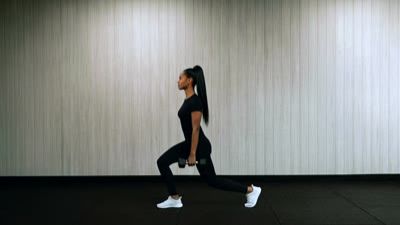
The Kettlebell Racked Reverse Lunge is a unilateral lower-body exercise that targets the quadriceps, glutes, and core. By holding the kettlebell in a racked position at chest height, this variation increases core stability demands and upper back engagement compared to standard lunges.

Since the rack position places isometric load on the shoulders and core, Iridium checks your recovery status for these secondary muscle groups to ensure they won't force you to end the set before your legs are fatigued. The AI also accounts for the extra duration required for unilateral movements, potentially substituting a bilateral variation if your defined session time limits are tight.
Form Cues
- Keep your wrist neutral and elbow tucked close to your ribs
- Brace your core to resist leaning toward the weighted side
- Step back far enough to create 90-degree angles at both knees
- Drive firmly through your front heel to return to standing
- Keep your chest tall and eyes gazing forward
- Don't let your front knee cave inward past your big toe
- Don't allow the kettlebell to pull your torso sideways
- Don't slam your back knee into the floor
- Don't flare your elbow out away from your body
- Don't let your front heel lift off the ground
Common Mistakes
- Taking too short of a step back
- Rounding the upper back forward
- Bending the wrist under the kettlebell handle
- Pushing off the back foot instead of the front foot
- Leaning excessively forward at the waist
Muscles Worked
This exercise primarily strengthens the quadriceps and glutes while challenging single-leg balance. The offset racked position places a significant demand on the core, specifically the obliques and spinal stabilizers, to maintain an upright posture against the asymmetrical load.
Primary
Secondary



Get Personalized Coaching for Racked Reverse Lunge (Kettlebell)
Don't guess your way through weights or workouts. Download Iridium for automatic, AI-powered coaching that adapts to your recovery and goals.