Walking Lunge (Dumbbell)
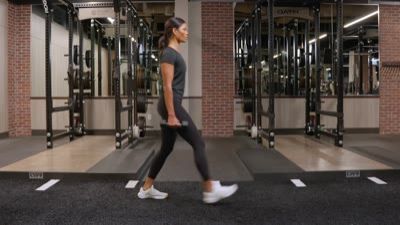
The Dumbbell Walking Lunge is a dynamic unilateral lower-body exercise that involves stepping forward continuously while holding weights. It primarily strengthens the quadriceps and glutes while significantly challenging your balance, core stability, and grip strength.
Since weighted walking lunges impose high systemic fatigue, Iridium reviews your sleep data and recent leg training volume to ensure you are recovered enough for high-intensity work. The algorithm tracks your RPE trends to regulate progressive overload, counting this workload toward your weekly Maximum Recoverable Volume for both quads and glutes.
Form Cues
- Keep your chest lifted and shoulders pulled back throughout the movement.
- Step far enough forward so your front shin remains roughly vertical at the bottom.
- Lower your hips until your back knee hovers just an inch off the ground.
- Drive firmly through your front heel to stand up and transition into the next step.
- Don't let your front knee collapse inward past your big toe.
- Don't slam your back knee into the floor on the descent.
- Don't 'tightrope walk' by stepping one foot directly in front of the other.
- Don't allow your torso to collapse forward or round your lower back.
Common Mistakes
- Taking steps that are too short
- Walking with feet too narrow (tightrope walking)
- Letting the front heel lift off the ground
- Banging the back knee on the floor
- Swinging the weights for momentum
Muscles Worked
This exercise provides a powerful stimulus for the quadriceps and glutes due to the deep range of motion and the need to decelerate the body with each step. It also heavily recruits the hamstrings and adductors for dynamic stability, while your core and forearms work isometrically to maintain upright posture and grip the dumbbells.
Primary
Secondary


Get Personalized Coaching for Walking Lunge (Dumbbell)
Don't guess your way through weights or workouts. Download Iridium for automatic, AI-powered coaching that adapts to your recovery and goals.