Cluster Sets for Strength and Size
Learn how cluster sets work, when to use them, and how to implement this advanced technique for both strength and hypertrophy gains. Includes sample workouts and programming guidance.
You've hit a plateau. Your standard sets aren't cutting it anymore. Maybe it's time to try cluster sets — one of the most effective yet underused techniques for breaking through sticking points.
Cluster sets allow you to lift heavier weights for more total reps than traditional sets. They're backed by research and used by elite athletes worldwide. Here's everything you need to know to implement them correctly.
What Are Cluster Sets?
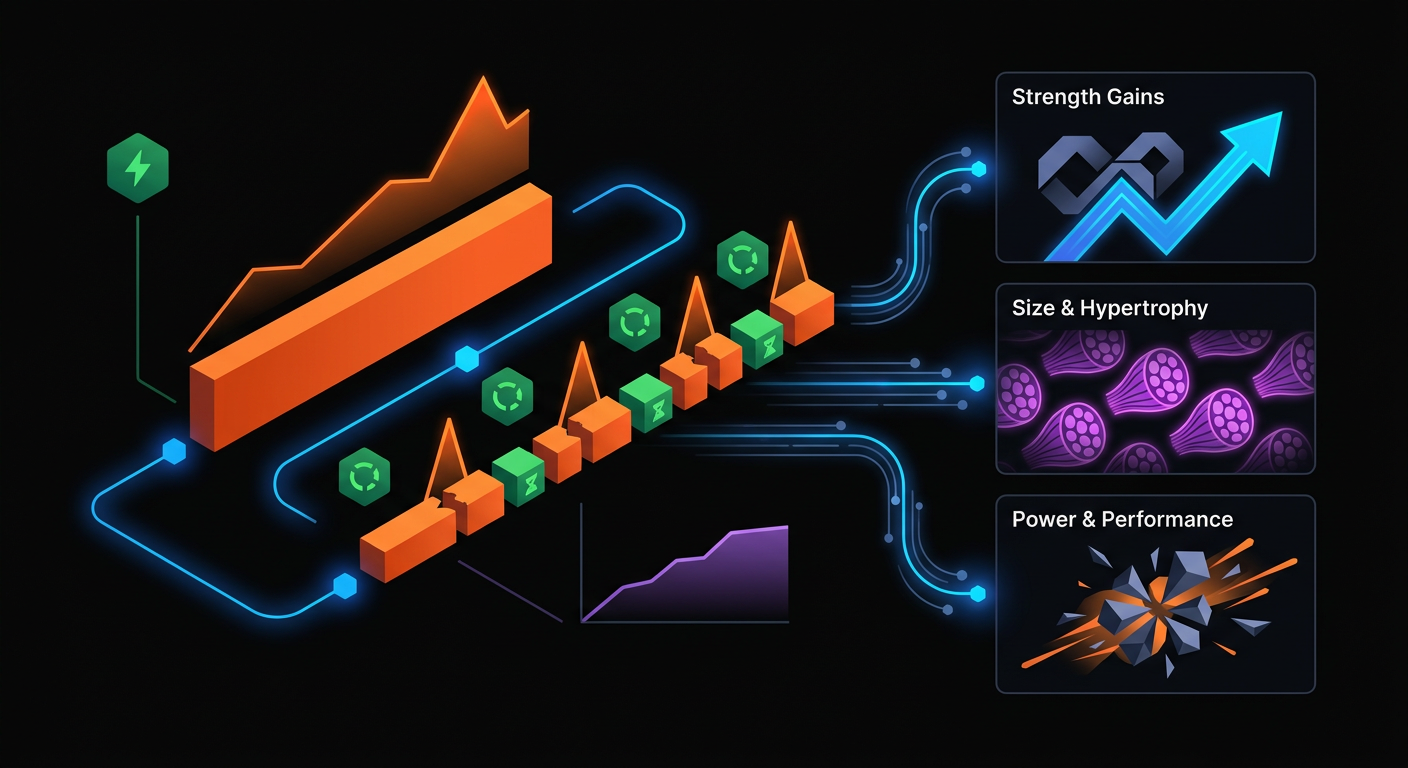
A cluster set breaks a single set into smaller "clusters" of reps with brief intra-set rest periods (typically 10-30 seconds). Instead of grinding through 5 straight reps, you might do 2 reps, rest 15 seconds, 2 more reps, rest 15 seconds, then a final rep.
This strategic rest allows partial ATP regeneration and phosphocreatine recovery, letting you maintain bar speed and form throughout the set (Tufano et al., 2016).
Traditional Set vs Cluster Set
Traditional approach: 5 reps straight through, velocity decreasing each rep, fatigue accumulating rapidly.
Cluster approach: 2-2-1 with 15-second rests between clusters. Higher average velocity, better form, same total reps.
The Science Behind Cluster Sets
Research consistently shows cluster sets offer unique advantages:
Maintained Power Output: A study in the Journal of Strength and Conditioning Research found that cluster sets allowed lifters to maintain significantly higher power output across all reps compared to traditional sets (Haff et al., 2003).
Higher Quality Reps: When researchers compared traditional sets to cluster sets at the same intensity, cluster sets produced faster bar velocities and better movement quality (Tufano et al., 2016).
Greater Total Volume at High Intensities: Because fatigue accumulates more slowly, you can often complete more total reps at a given weight. This has significant implications for both progressive overload and long-term strength development.
When to Use Cluster Sets
Cluster sets aren't for every situation. Use them strategically:
Best Applications
Strength Development: When training at 85-95% 1RM, cluster sets allow more high-quality reps at peak intensities. This exposure to heavy loads drives neural adaptations.
Power Training: Athletes who need maximal bar speed (Olympic lifters, sprinters, jumpers) benefit from the maintained velocity.
Breaking Plateaus: When your standard 5x5 or 3x8 stops progressing, cluster sets provide a novel stimulus.
Technical Improvement: The brief rests let you reset mentally and maintain better form on complex lifts.
When to Avoid Them
- Metabolic conditioning: The rest periods reduce the metabolic stress that drives certain adaptations
- Time-crunched sessions: Cluster sets take longer than traditional sets
- Beginner lifters: Master basic set/rep schemes first
How to Structure Cluster Sets
Several cluster formats work well, depending on your goals:
For Strength (85-95% 1RM)
2-2-1 Clusters: 5 total reps broken into clusters of 2, 2, and 1 with 15-20 seconds rest between clusters.
Singles Clusters: 5-6 singles with 20-30 seconds rest between each rep. Excellent for maximal strength.
For Hypertrophy (75-85% 1RM)
3-2-2 Clusters: 7 total reps broken into clusters with 10-15 seconds rest. Higher volume per set while maintaining quality.
4-3-3 Clusters: 10 total reps when traditional sets would give you 8. More volume at challenging weights.
Rest Period Guidelines
| Goal | Intra-Set Rest | Inter-Set Rest |
|---|---|---|
| Maximal Strength | 20-30 seconds | 3-5 minutes |
| Power | 15-20 seconds | 3-4 minutes |
| Hypertrophy | 10-15 seconds | 2-3 minutes |
Getting the intra-set rest right is critical — too short and you don't recover enough, too long and you lose the cluster effect. Iridium's smart rest timer handles this automatically, adjusting rest duration based on the exercise type and set intensity so you don't have to watch the clock.
Sample Cluster Set Workouts
Strength Focus: Bench Press Day
Main Lift — Cluster Sets:
- Bench Press: 5 sets of (2-2-1) at 87.5% 1RM
- Rest 20 seconds between clusters, 4 minutes between sets
Accessory Work — Traditional Sets:
- Incline DB Press: 3x10
- Cable Flyes: 3x12
- Tricep Pushdowns: 3x15
Power Focus: Squat Day
Main Lift — Singles Clusters:
- Back Squat: 4 sets of 5 singles at 85%
- Rest 25 seconds between singles, 4 minutes between sets
Accessory Work:
- Romanian Deadlift: 3x8
- Leg Press: 3x12
- Leg Curls: 3x15
Hypertrophy Cluster Protocol
Modified Rest-Cluster for Size:
- Select a weight you'd normally get 8 reps with
- Perform 4 reps, rest 10 seconds
- Perform 3 reps, rest 10 seconds
- Perform 2-3 more reps
- Total: 9-10 reps with a weight that would normally limit you to 8
This approach accumulates more volume at challenging loads — a key driver of hypertrophy.
Programming Cluster Sets
Don't jump straight to cluster sets for every exercise. Phase them in strategically:
Week 1-2: Traditional training, establish baseline performance Week 3-4: Introduce clusters on one main lift Week 5-6: Expand to 2 lifts if recovering well Week 7-8: Deload, then reassess
Exercise Selection
Cluster sets work best on:
- Compound lifts: Squat, bench, deadlift, overhead press, rows
- Power movements: Cleans, snatches, push press
- Isolation lifts (occasionally): Heavy curls, tricep work
Avoid them on:
- Exercises with high technique demands during fatigue (Olympic lifts for beginners)
- Isolation movements where fatigue is the goal (burnout sets)
Common Mistakes to Avoid
Resting Too Long: If your intra-set rest extends beyond 30 seconds, you're essentially doing rest-pause training or straight sets. Keep it tight.
Using Them Exclusively: Cluster sets are a tool, not a complete program. Mix them with traditional sets, drop sets, and other methods.
Ignoring Total Volume: Track your weekly sets per muscle group. Cluster sets can make high-intensity training more manageable, but you still need adequate volume for growth. Iridium tracks your per-muscle weekly volume against your MEV, MAV, and MRV landmarks, so you can see at a glance whether you're in the optimal growth zone or drifting into junk volume territory.
Starting Too Heavy: Begin with weights you can control perfectly. Add load over time.
Tracking Your Cluster Sets
Monitoring progress with cluster sets requires attention to:
- Total reps at a given weight: Are you accumulating more quality reps over time?
- Bar velocity: If available, track speed. It should remain consistent across clusters.
- RPE per cluster: Rate the first and last cluster. The gap should narrow as you adapt.
Iridium's per-set logging lets you record each cluster individually — weight, reps, and RPE — so you can track how performance shifts across clusters over weeks. The AI set analysis can also review your completed clusters and adjust remaining sets if you're outperforming or underperforming your targets.
The Bottom Line
Cluster sets bridge the gap between strength and volume. By inserting brief rests within sets, you maintain bar speed, preserve form, and accumulate more high-quality reps at challenging weights.
They're not magic — but for intermediate and advanced lifters stuck on plateaus or seeking novel stimulus, clusters are a proven tool backed by research.
Start conservative. Track everything. Adjust based on your response.
Ready to track your cluster sets and optimize your training? Download Iridium — the AI-powered workout app that adapts to your performance and helps you progress systematically. image: "/blog/cluster-sets-guide-hero.png"
Related Posts
Drop Sets: When and How to Use Them
Learn the science behind drop sets, when to use them, optimal weight reductions, and common mistakes. A complete guide to this powerful intensity technique.
Progressive Overload: The Only Rule That Matters
Master the one principle that drives all muscle and strength gains. Here's exactly how to implement progressive overload.
PHAT Program: Power Hypertrophy Adaptive Training Guide
Complete guide to the PHAT program. Covers the 5-day power hypertrophy adaptive training split, exercise selection, and who it's best for.