Decline Crunch
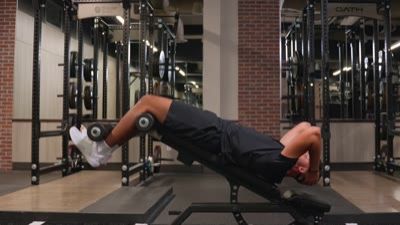
The Decline Crunch is a core strengthening exercise performed on a decline bench to increase gravitational resistance and range of motion. It primarily isolates the upper rectus abdominis while engaging the deep core stabilizers more intensely than a standard floor crunch.

Iridium tracks your RPE and rep counts relative to body weight to determine when gravity alone is no longer driving adaptation, prompting the addition of external weight when necessary to maintain progressive overload. Since this movement creates significant upper ab fatigue, the AI checks your 7-day workout history to ensure this volume fits within your abdominal maximum recoverable volume (MRV).
Form Cues
- Secure your feet firmly under the pads to prevent sliding
- Contract your abs deeply to curl your shoulders off the bench
- Exhale forcefully as you crunch up towards your knees
- Lower your torso slowly and with control to resist gravity
- Keep your chin tucked slightly to protect your neck
- Don't pull on your neck or head with your hands
- Don't use momentum or swing your body to get up
- Don't lift your lower back off the bench
- Don't let your head slam back onto the bench between reps
- Don't perform a full sit-up; stop when the abs are fully contracted
Common Mistakes
- Pulling on the neck
- Using momentum to swing up
- Lifting the lower back
- Holding breath during exertion
- Excessive range of motion
Muscles Worked
This exercise isolates the rectus abdominis, specifically emphasizing the upper region due to the spinal flexion movement pattern. By positioning your body on a decline, gravity provides constant tension throughout the rep, forcing your core to work harder than it would on a flat surface to stabilize the spine and control the descent.
Primary
Secondary



Get Personalized Coaching for Decline Crunch
Don't guess your way through weights or workouts. Download Iridium for automatic, AI-powered coaching that adapts to your recovery and goals.