Plank Surrender
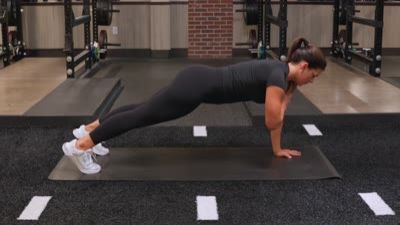
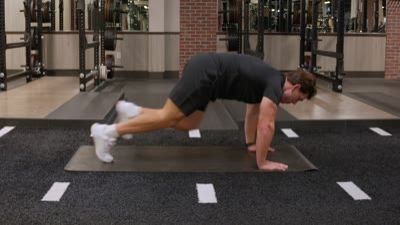
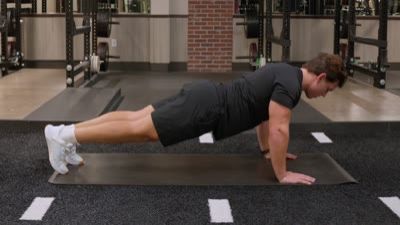
The Plank Surrender is a dynamic core exercise that involves transitioning between a forearm plank and a high plank position. This movement builds upper body strength and core stability by challenging your ability to resist rotation while changing levels.

Since Plank Surrenders rely heavily on the anterior deltoids and triceps, Iridium checks your per-muscle recovery status to ensure recent pushing workouts haven't pre-exhausted your necessary stabilizers. The AI attributes volume from these sets to your shoulder and tricep totals, ensuring you stay within your Maximum Recoverable Volume for those groups. Additionally, Iridium tracks your performance relative to body weight to accurately detect progressive overload trends.
Form Cues
- Brace your core tightly to lock your hips in place
- Place your hand directly beneath your shoulder to push up
- Drive through the palm to extend your arm fully
- Alternate your lead arm with every repetition
- Keep your body in a straight line from head to heels
- Don't let your hips rock side-to-side
- Don't allow your lower back to sag toward the floor
- Don't place your hands too far forward in front of your shoulders
- Don't rush the movement at the expense of stability
- Don't let your head drop or neck strain
Common Mistakes
- Excessive hip shifting or wobbling
- Hyperextending the lower back
- Always leading with the same arm
- Flaring elbows out too wide
- Holding the breath during the transition
Muscles Worked
This exercise primarily targets the entire core complex, specifically forcing the transverse abdominis and obliques to work overtime to prevent hip rotation during the single-arm support phases. Secondarily, it builds functional endurance in the anterior deltoids and triceps as they repeatedly lift and lower your bodyweight against gravity.
Primary
Secondary

Get Personalized Coaching for Plank Surrender
Don't guess your way through weights or workouts. Download Iridium for automatic, AI-powered coaching that adapts to your recovery and goals.